The Hand-Coding Ban Is Coming. The IT Jobs Apocalypse Isn't.
When human keystrokes become the riskiest way to produce software, enterprise IT doesn't disappear. It becomes a mission-engineering discipline—and the demand for outcomes may explode.

Software engineering is approaching a peculiar moment: the industry may actually decide that letting a human type production code by hand is an unnecessary risk.
Not because people are not capable. Because people are expensive, inconsistent, difficult to scale, and—most importantly—no longer the only available means of producing an implementation.
We have seen this movie before. We don't ask airline pilots to hand-fly every routine segment to demonstrate professionalism. We don't insist that factory workers manually position every component when robotics can achieve tighter tolerances. We don't ask database administrators to hand-place records on disks. In each case, we progressively moved the human from repetitive execution toward supervision, exception handling, systems design, and accountability.
There is an important caveat: aviation automation, industrial robotics, and clinical safety systems succeed only when engineered, independently verified, and operated inside explicit boundaries. Automation can also produce catastrophic common-mode failures. That is the point. The objective is not to replace human judgment with machine improvisation. It is to stop confusing human involvement in every low-level action with safety.
Software is next. And the people announcing the death of the developer have fundamentally misunderstood the economics.
The last respectable defense of hand coding
On October 12, Bloomberg reported that Epic Games delayed a Disney-related game and moved its development team toward an AI-first production model. A project director's internal instruction was unusually direct: no more handwritten code. Epic's broader leadership described a pivot intended to expand output rather than simply eliminate staff. Admittedly, this was a reported direction for a specific project, not proof of a universal company-wide prohibition, but it’s a prime example of what’s coming. 1.
That distinction matters, but not as much as the signal. Epic is a technically sophisticated game-engine company. When a serious engineering organization starts treating manual implementation as an exception, the debate shifts from whether AI can write code to why a human should write each line.
The most credible argument against banning manual code is not sentimentality. It is that current agents still make consequential mistakes, especially in security and systems integration. Endor Labs' Agent Security League benchmark, updated with September and October model runs, reports a top functional-correctness score of 87.2%, but a top security-correctness score of only 37.4% across its tested agent/model combinations. Those numbers are benchmark-specific, not a universal production failure rate. They do, however, demolish the notion that generated code should bypass adversarial validation. 2.
So here is the contrarian position: the right destination is not a blind prohibition on human code. It is a policy under which manually authored implementations must justify themselves against a better, more repeatable, more testable automated path. Hand coding becomes an exception because the process is demonstrably inferior for a growing class of tasks—not because AI is magically infallible.
The next IT operating model has a different center of gravity
I suggest that we should call the emerging role Mission Engineering. The term is older than today's agent systems; the mandate is radically new.
The Mission Engineer defines the outcome, decomposes it into verifiable requirements, designs the architecture and constraints, directs fleets of specialized agents, verifies evidence, manages exceptions, and owns the result. Their work product is not primarily source code. It is a functioning, governed system that meets its mission.
This changes the structure of enterprise IT. Application teams become portfolios of mission owners, platform engineers, verification specialists, and autonomous execution capacity. Operations shifts from dashboards and ticket queues toward policy-governed remediation. Testing shifts from manually maintained scripts toward generated scenarios, adversarial evaluation, property-based checks, and continuous proof. SecOps shifts from endless alert triage toward machine-speed detection, containment, and independently verified recovery. Infrastructure teams specify reliability, cost, sovereignty, and latency envelopes, then continuously optimize against them.
These are not four disconnected automation projects. They are one operating model: Intent in. Evidence out.
Every autonomous change needs a bounded permission set, a reproducible build, explicit acceptance tests, observability, rollback, and a named human accountable for the outcome. Agents should propose and execute inside those constraints. Humans should arbitrate ambiguous objectives, trade-offs, ethics, and irreversible decisions. The line is not human versus machine. It is measurable execution versus judgment under uncertainty.
Google's DORA research warns why this distinction matters: its earlier generative-AI analysis found that a 25% increase in AI adoption was associated with a 1.5% decline in delivery throughput and a 7.2% decline in delivery stability. These are observational associations, not proof that AI itself caused the deterioration. 3.
The lesson is devastating for companies that buy coding assistants but leave their operating model intact: faster typing into a broken delivery system just breaks things faster.
The employment apocalypse runs into Jevons
Now the inconvenient data.
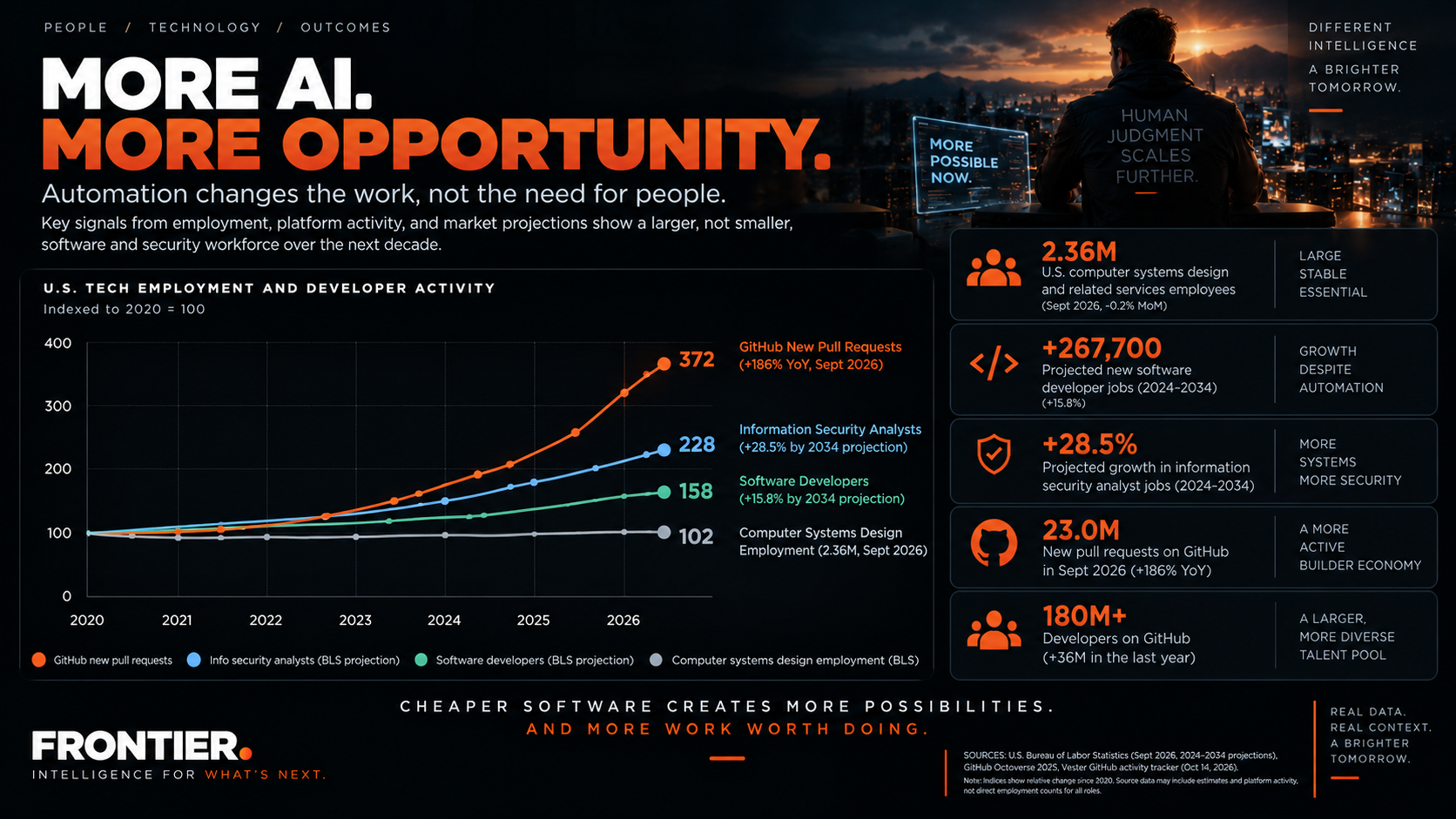
For the underlying source-linked figures, methodology, and clearly identified synthetic demand-rebound scenario, see the Frontier Data Insight: More AI. More Opportunity. The Mission Engineering Rebound. 4
The Bureau of Labor Statistics projects 15.8% growth in U.S. software developer employment from 2024 to 2034—about 267,700 additional developer jobs. It also projects 28.5% growth for information security analysts. These are projections, not guarantees, and they predate some of the latest model advances. But they are not consistent with the confident assertion that demand for technology professionals must collapse as automation improves. 5.
More immediately, September 2026 payroll data show 2.355 million employees in U.S. computer systems design and related services, seasonally adjusted, down modestly from August's 2.360 million. This is an industry measure, not a count of software developers, and the near-term decline should not be airbrushed away. It demonstrates pressure, not extinction. 6.
GitHub's own Octoverse 2025 counted more than 180 million developers on the platform after more than 36 million joined in a year. Caveat: That is a platform account count, not an employment measure. 7.
A third-party tracker using public GitHub activity estimates 23.0 million new pull requests in September 2026, up 186.5% year over year, and 11.9 million new repositories, up 109.1%. These figures are derived from platform activity and may include automated or nonproduction work; they are not GitHub's official employment statistics. But they suggest an extraordinary expansion in the volume of things being built. 8.
Enter Jevons Paradox: efficiency can increase total consumption when lower costs unleash latent demand. Originally articulated around coal, it is not a universal law of software labor. The rebound effect is the more precise mechanism: cheaper software production can generate more applications, integrations, experiments, tests, controls, and operational responsibilities than organizations previously could afford.
Think about the millions of departmental workflows never automated because the business case couldn't survive a six-month development queue. The legacy integrations deferred for years. The personalized customer experiences too expensive to create. The security controls too labor-intensive to implement. The data products nobody had the capacity to maintain. Every drop in the cost of creating and operating these systems expands the frontier of economically viable work.
But here is the twist: code may become abundant while mission accountability becomes scarce.
A company that once maintained 500 applications may soon supervise 5,000 purpose-built systems, agents, integrations, and workflows. That number is illustrative, not a forecast. If ten times as many systems require only one-tenth as much direct labor each, the headcount arithmetic is flat—not catastrophic. If the new systems require governance, integration, security, compliance, and continuous optimization, demand for high-skill oversight may increase. If adoption is slower or consolidation dominates, employment can decline. Jevons is a plausible strategic mechanism, not a promise that every coder keeps their job.
This is why the slogan "AI will replace developers" is analytically lazy. AI can eliminate tasks, displace roles, create entirely new work, and expand total output simultaneously. The labor outcome depends on demand elasticity, organizational redesign, and how quickly people acquire the new skills.
The new scarce skill is owning reality
Vibe coding is a useful on-ramp. Prompt engineering is a technique. Software architecture remains essential. None captures the full accountability of the emerging role.
Mission Engineering does.
The great Mission Engineer can express an ambiguous business objective as measurable outcomes; choose where automation belongs and where it does not; establish technical and economic guardrails; coordinate coding, test, operations, and security agents; inspect evidence rather than admire demos; and make hard decisions when requirements conflict.
They will still need deep technical literacy. In fact, the better the agents get, the more expensive superficial understanding becomes. Someone must recognize a false positive, a hidden coupling, an untestable requirement, an elegant-looking security hole, a quietly exploding inference bill, or an architecture that cannot be operated.
The old developer's heroic story was shipping a difficult implementation. The new one is making thousands of implementations dependable. The old operator fixed the outage. The new one designs systems that detect, contain, recover, and learn before the outage becomes a business event. The old security analyst investigated alerts. The new one engineers provable limits on what autonomous systems can do—and proves that those limits hold under attack.
This is a promotion in responsibility, not necessarily in comfort. Plenty of established skills will depreciate. Some organizations will cut staffing. The transition will be brutal for workers who are not supported in retraining. Anyone promising frictionless job preservation is selling fantasy. But so is anyone forecasting an empty IT department.
The next CIO mandate: industrialize outcomes
There are three moves worth making now.
First, classify work by verifiability, not job title. Identify coding, testing, remediation, configuration, and security tasks with explicit success criteria, measurable error rates, and reversible actions. Automate those first. Keep humans closest to ambiguous objectives, high-impact exceptions, and irreversible decisions. Measure quality-adjusted cycle time, not generated lines of code.
Second, build an evidence-based mission platform. Give agents controlled tools, isolated execution environments, policy-as-code, continuous evaluation, provenance, telemetry, cost budgets, and rollback. Make automated test and security evidence the price of admission for production changes. Do not allow an AI-generated patch to become a privileged shortcut around engineering discipline.
Third, reorganize talent around missions and accountability. Start measuring teams by customer outcomes, service reliability, economic efficiency, and risk reduction. Create progression paths from developer, SRE, QA, and security analyst to Mission Engineer, verification architect, and autonomous-systems operator. Invest in deep systems knowledge and business fluency rather than treating prompt fluency as a career strategy.
There will come a day when a senior engineer is asked why they manually wrote a routine production component instead of specifying its requirements and letting a governed automation system build and prove it. The question will sound less like an insult and more like asking why a pilot declined the autopilot during an ordinary cruise.
We are not there universally. But we can see the direction. The end of hand coding will not be the end of engineering. It will be the end of pretending that engineering was ever principally about the hands.
AI produces the code. Mission Engineers produce the results.
And there are about to be far more results worth producing.
Sources and data
1: Bloomberg, October 12, 2026 — Epic Games' Disney project and AI-first development direction. Reported project-specific direction; not a verified company-wide ban.
2: Endor Labs — Agent Security League. Benchmark-specific functional and security correctness; not a universal production defect rate.
3: Google DORA — Impact of Generative AI in Software Development. Observational associations, not causal proof.
5: U.S. Bureau of Labor Statistics — Industry and Occupational Employment Projections. Ten-year occupational forecasts, not realized employment.
6: U.S. Bureau of Labor Statistics — September 2026 Employment Situation. Computer systems design and related services industry payroll employment; not a software developer occupation count.
7: GitHub Octoverse 2025 — Developer platform growth. Platform accounts are not employed developers.
8: Third-party GitHub activity tracker — September 2026. Estimated repository and pull-request activity may include automation; not an official GitHub employment series.
4: Frontier Research Data Insight — More AI. More Opportunity. The Mission Engineering Rebound.. Source-linked measures and machine-readable dataset in the published CMS object. The rebound scenario is explicitly synthetic and illustrative, not observed or forecast employment.
[^epic-bloomberg][^endor-benchmark][^dora-research][^bls-projections][^bls-employment][^github-octoverse][^github-tracker]