Cloudflare Ate the Edge. Now It Makes a Move for the Whole Cloud.
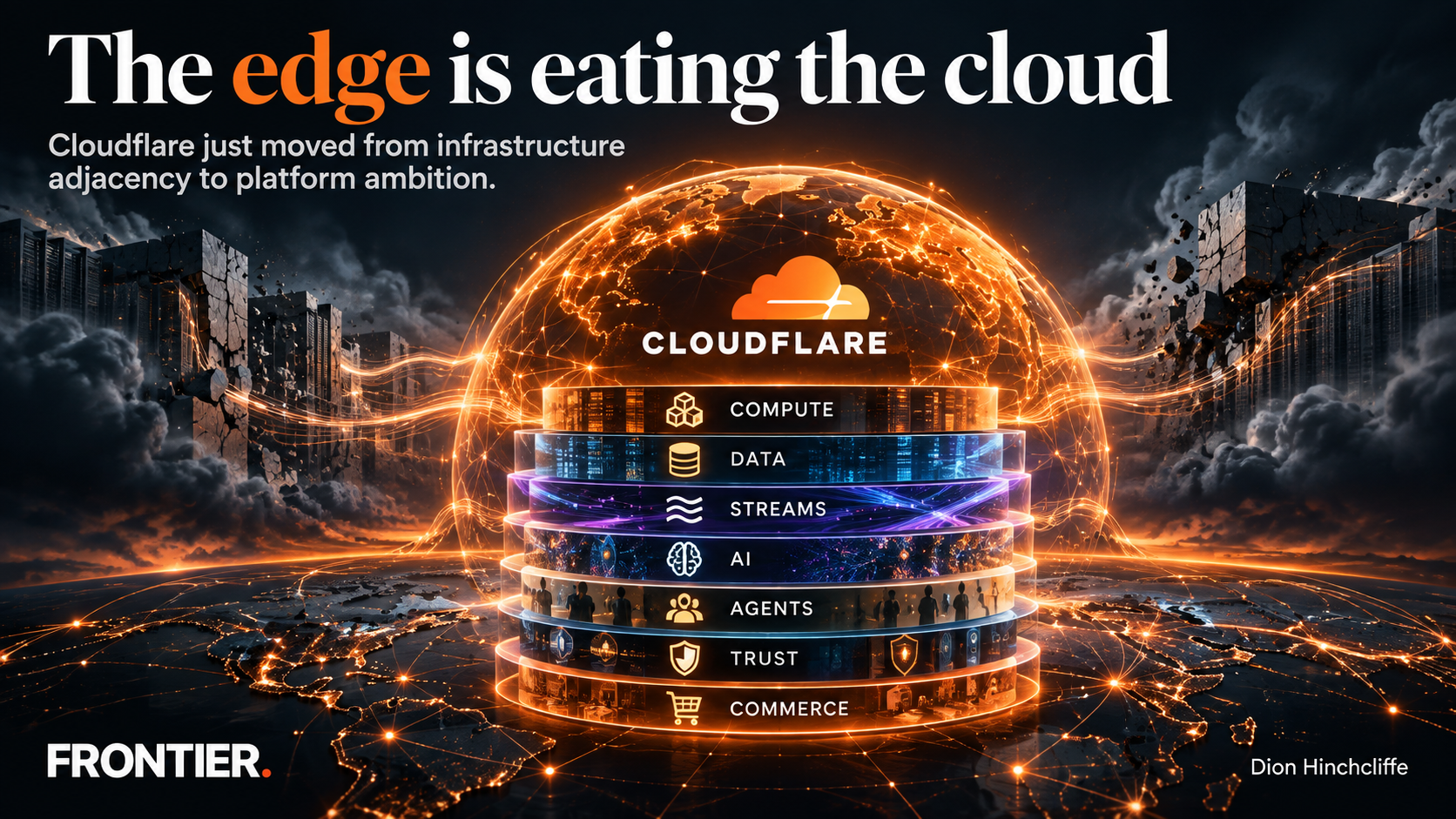
Birthday Week 2026 reveals a coherent strategy: Cloudflare is assembling an agent-native global cloud across compute, data, streaming, AI control, developer tooling, monetization, and Internet trust.
What changed
Cloudflare spent its sixteenth Birthday Week doing something more consequential than shipping a pile of features. It exposed the outline of a new company.
The familiar Cloudflare sits in front of applications: DNS, CDN, DDoS protection, WAF, Zero Trust, network connectivity. The emerging Cloudflare wants to sit under, around, and increasingly inside the entire lifecycle of an agent-native application — where it executes, where its data lands, how its events move, which AI model it calls, how its agents are governed, how code is built and repaired, how machine traffic pays for resources, and even how Internet trust is issued.
Cloudflare's founders framed the timing clearly. The company says more than seven million developers now build on its developer platform, and automated traffic passed human traffic in May 2026 — much earlier than Cloudflare had forecast — because agent and crawler traffic is exploding.1 Independent reporting has been pointing in the same direction: agent workloads behave differently from human workloads, creating bursty, parallel, globally distributed demand that forces infrastructure providers to redesign around machines rather than browsers and people.2
Birthday Week 2026 is Cloudflare's answer to that shift.
The most important announcements form a surprisingly coherent stack:
| Layer | What Cloudflare shipped | Strategic meaning |
|---|---|---|
| Compute | Containers rebuilt for agent sandboxes, with runtime image and instance selection, substantially faster startup, and filesystem snapshots | Agent execution becomes a first-class workload rather than a container use case. |
| Data | Basin GA: ingestion, Iceberg catalog, distributed SQL, and R2 object storage | Cloudflare moves directly into the analytical data plane. |
| Streaming | K2 serverless event streams | A Cloudflare-native durable log challenges the assumption that event streaming means Kafka infrastructure. |
| AI control | AI Gateway Auto Router and richer User Insights | Cloudflare wants to become the neutral policy and economics layer between applications, users, agents, and model providers. |
| AI primitives | Clef and Clef-flash decision models plus RL fine-tuning | Cloudflare is no longer only serving other companies' models; it is training purpose-built models for agent decisions. |
| Agent workspace | Managed Cloudflare OS waitlist | Cloudflare moves upward from agent infrastructure into the enterprise work surface. |
| Retrieval | AI Search GA with multimodal embeddings and PDF OCR | RAG/search becomes another integrated Cloudflare service built on Workers AI, Vectorize, R2, and Browser Run. |
| Global state | Workers KV Instant, exposing Quicksilver-derived replication | Internal Cloudflare infrastructure becomes a customer-facing application primitive. |
| Software delivery | Agentic cf CLI, Artifacts, agent-linked Issues, Forge | Cloudflare is starting to assemble an agent-native development and operations lifecycle. |
| Commerce | Monetization Gateway and Pay Per Use | Cloudflare wants to mediate machine-to-machine economic exchange, not merely network traffic. |
| Trust | Planned public certificate authority and post-quantum issuance | Cloudflare is moving deeper into the root trust layer of the Internet itself. |
The individual products matter. The continuity between them matters more.
Data is the clearest declaration of intent
Cloudflare Basin is the announcement most likely to make traditional infrastructure buyers recalibrate the company.
Basin is now generally available as an end-to-end serverless analytics platform: Basin Pipelines ingests and transforms events, Basin Catalog manages Apache Iceberg tables, and Basin SQL queries them directly on Cloudflare. It is built on R2 and Apache Iceberg, with Cloudflare emphasizing open formats, no data-egress fees, and usage-based serverless economics rather than standing clusters.3
That is no longer CDN adjacency. It is data-platform territory.
The architecture is strategically clever. Iceberg reduces format lock-in, while R2's egress model makes it practical for customers to leave data on Cloudflare while using other engines. Cloudflare says Basin Pipelines can ingest up to 3 GB/s per stream and explicitly expects customers to query the same data from Cloudflare or external tools.3 Independent analysis from SiliconANGLE characterized Basin as a direct move beyond Cloudflare's historical CDN/security base and into workloads served today by Snowflake, Databricks, and cloud-native analytics stacks; the publication also noted that the likely first impact is at the edge of those markets rather than wholesale replacement of mature enterprise warehouses.4 The Register similarly highlighted Iceberg interoperability and lack of egress fees as Basin's main wedge against hyperscaler storage economics.5
K2 makes the move more important. K2 is a public-beta durable event-streaming service built as a partitioned log over R2. Cloudflare says it originally needed K2 because its edge architecture across more than 335 cities is not naturally suited to running traditional distributed systems such as Kafka everywhere. Rather than reproduce Kafka, it offloads durability and consensus into object storage, then scales the application layer independently.6
That is a recurring pattern in this week's announcements: Cloudflare is not copying the regional cloud. It is redesigning cloud primitives around its own network topology.
Cloudflare is building the agent runtime above that data plane
The container changes are explicitly agent-driven. Cloudflare says agent sandboxes need to be created on demand, selected dynamically for each task, paused, resumed, and started much faster than conventional container infrastructure assumes. The new Containers architecture lets application code choose image and instance type at runtime; Cloudflare reports roughly 6x faster startup, with an independent benchmark cited in its announcement measuring median startup around 648 milliseconds.7
That sits naturally beside K2 and Basin. An agent can wake up globally, spin up isolated compute, consume an event stream, operate against durable data, call models through AI Gateway, and shut down again without the buyer provisioning a regional cluster.
Cloudflare OS then moves one level higher. The open-source workspace already lets organizations connect agents to company context and systems; the new managed offering will let customers deploy it through Cloudflare with Access policies and AI Gateway attached. Cloudflare says thousands of organizations have tried the open-source version since its August launch, and the managed service is now on a waitlist.8
That makes Cloudflare OS strategically different from a generic chat front end. It is a showcase for the complete Cloudflare stack underneath: identity, access, Workers, agent execution, model routing, data connections, and application generation.
AI Gateway is becoming a control plane, not a proxy
User Insights now analyzes which users and agents are driving AI consumption, the kind of work being performed, conversation turns, task complexity, latency, tokens, and cost. Cloudflare's Auto Router uses related signals to choose models according to task fit and economics rather than simply sending every request to a default frontier model.910
That is a subtle but important move. The neutral AI gateway becomes the place where the enterprise can answer: who is consuming intelligence, for what work, at what price, using which model, under which policy?
Cloudflare is effectively betting that enterprises will not want those decisions controlled entirely by the model vendor.
Clef pushes further. Cloudflare trained and open-sourced Clef and Clef-flash as decision models designed to return bounded structured choices rather than free-form text. They run on Workers AI and are paired with a reinforcement-learning fine-tuning platform.11 That is useful for agent workflows where a small, fast, structured decision can be preferable to invoking an expensive general-purpose reasoning model.
AI Search, now generally available, similarly collapses another layer of the agent stack into Cloudflare by integrating Workers AI, Vectorize, R2, and Browser Run into a managed retrieval pipeline, with native image embeddings and PDF OCR added at GA.12
The software factory is starting to move too
Cloudflare is also aiming directly at how machine-generated software gets built and operated.
The new cf CLI exposes more than 2,900 commands covering the public Cloudflare API, returns structured output, supports typed programmatic configuration, and is explicitly designed so coding agents can discover and execute commands.13 Forge is the open-source generator behind that CLI and is intended to generate SDKs, documentation, and other interfaces directly from API definitions.14
Artifacts, Cloudflare's Git-compatible versioned storage, is now in open beta with Workers bindings, deployment integration, jurisdiction controls, metrics, and repository event subscriptions. Cloudflare is openly challenging developers to build "the next Git platform" for a world in which hundreds or thousands of agents may work concurrently on the same codebase.15
Workers Issues closes another loop: production failures can be grouped automatically with stack traces, logs, traces, and Worker versions, then handed directly to a coding agent that can investigate and open a pull request.16
GitHub is already aggressively moving in the same direction, with Copilot and third-party agents operating asynchronously across issues, pull requests, code review, and enterprise governance.17 Cloudflare is not replacing GitHub today. But it is attacking a deeper assumption: that agentic software production must continue to orbit a human-designed repository and CI model.
And then Cloudflare added an economic layer
The most unusual part of the strategy is that Cloudflare is not stopping at infrastructure.
Its Monetization Gateway, now in closed beta, lets owners charge AI agents for access to websites, APIs, MCP tools, and datasets using HTTP 402 and x402 payment flows. Cloudflare handles payment verification, settlement, failures, retries, and analytics.18 Pay Per Use applies a related model to content, letting publishers define terms while AI buyers report downstream usage and Cloudflare handles billing and payout.19
The New Stack identified the governance wrinkle: once agents can autonomously pay for tools, spending authority becomes part of the agent runtime and policy model, not simply a finance process.20
Cloudflare is trying to become the place where machine traffic is identified, authorized, routed, priced, paid, secured, and observed.
That is much larger than edge cloud.
Even the trust layer is moving inward
Cloudflare also announced its intent to become a public certificate authority. It has applied to the Chrome, Apple, Microsoft, and Mozilla root programs and signed an agreement to acquire a broadly trusted GlobalSign root, while targeting post-quantum Merkle Tree Certificates for future issuance.21
The service is not issuing certificates yet, so this is a strategic commitment rather than a shipping replacement for incumbent CAs. But the direction is significant: Cloudflare increasingly wants to own not just the path packets travel, but more of the trust, identity, and policy machinery that determines whether machine interactions should happen at all.
Why it matters
The easiest way to misunderstand this week is to say Cloudflare is trying to become another AWS.
It is not.
AWS, Microsoft Azure, and Google Cloud were built around regions, data centers, broad infrastructure catalogs, enterprise accounts, and enormous ecosystems. Cloudflare's advantage comes from a different starting point: it already sits in the request path of a significant portion of the Internet.
That changes what it can combine.
A traditional cloud starts with compute and storage, then extends outward toward users through CDNs, edge services, API gateways, and security layers. Cloudflare is executing the inverse strategy. It started at the Internet edge and is steadily pulling compute, storage, data, AI, identity, developer tooling, and economic exchange inward.
The result is an emerging architecture that can be summarized as:
Internet traffic → identity/security → compute → streams → data → AI/model policy → agents → commerce
All on one global network and increasingly one control plane.
That is an especially interesting fit for agent workloads. Agents are bursty. They create many short-lived tasks. They fan out across APIs and websites. They need sandboxes, event streams, retrieval, state, model choice, identity, spend controls, and increasingly machine-native payment. They also do not care nearly as much as humans do where a region is; they care whether the next action can execute quickly, safely, and close to the relevant system.
Cloudflare's edge heritage becomes more valuable, not less, in that environment.
The market position: the agent-native Internet cloud
Frontier's read is that Cloudflare is creating a category distinct from both hyperscale IaaS and classic edge infrastructure:
an agent-native Internet cloud.
It is global by default rather than region-first. It is serverless by default rather than VM-first. It is increasingly open-format by default in the data layer. It is model-neutral in AI Gateway. It combines identity, security, traffic, and execution because those already share Cloudflare's network. And it is beginning to add native economic rails for machine traffic.
This is a more defensible position than simply being "the fourth cloud." The hyperscalers are nearly impossible to out-AWS at AWS's own game. But Cloudflare does not need to match every managed database, ERP integration, GPU instance, and enterprise marketplace SKU if the fastest-growing class of new workloads increasingly begins at the edge of the Internet and behaves like software agents rather than human-driven applications.
That is the wedge.
Who should be worried
AWS, Azure, and Google Cloud — but mainly at the edge of new workloads
The hyperscalers face the broadest strategic pressure, but not because Cloudflare is about to absorb legacy VM estates.
The threat is greenfield gravity.
A development team building a globally distributed agentic application can increasingly get execution, object storage, vector retrieval, event streaming, analytics, model routing, security, identity, and deployment from Cloudflare before it needs to create a traditional cloud footprint at all. If the system of record remains in AWS, Azure, or GCP, Cloudflare can still sit above it as the global interaction and agent layer.
That changes the architectural default from "pick a hyperscaler, then add Cloudflare" to "start on Cloudflare, then attach hyperscaler services only where necessary."
That is strategically significant because the first platform to own the developer workflow often captures the next layers of spend.
Cloudflare is not yet a substitute for the hyperscalers' deepest infrastructure capabilities: large-scale GPU training, broad relational/database portfolios, enterprise application ecosystems, private-cloud integration, or specialized regulated-region offerings. Many Birthday Week services are also beta or early. But Cloudflare no longer needs to win an all-or-nothing migration to erode hyperscaler growth at the margin.
Snowflake and Databricks — at the ingestion and open-data perimeter
Basin's most immediate target is not the Fortune 100 enterprise warehouse. It is the growing universe of logs, telemetry, product events, application analytics, and AI data that organizations would rather land once in an open format and access from many tools.
Snowflake has itself moved aggressively toward open Iceberg interoperability and external engine access, while Databricks continues to expand serverless SQL and lakehouse infrastructure.2223 Those platforms remain far deeper in governance, data engineering, BI, ML, semantic tooling, and enterprise analytics.
But Cloudflare has a dangerous wedge: it is already where a great deal of raw event data is generated or passes through.
If Basin becomes the cheapest and easiest place to land that data, Snowflake and Databricks risk becoming downstream query engines rather than the default home of the data. Over time, the owner of ingestion, storage economics, and the open catalog can move further up the stack.
This is why the egress-free Iceberg architecture matters more than the SQL engine alone.
Confluent and managed Kafka — wherever buyers want streams without Kafka
K2 is a more direct competitive shot.
Cloudflare needed a durable event layer for its own edge architecture and concluded that traditional Kafka was a poor fit across hundreds of globally distributed locations. K2's answer is to put the durable log on R2, separate storage from compute, and make the service fully serverless.6
Confluent and Kafka remain extraordinarily mature for complex streaming ecosystems. K2 is beta and does not yet reproduce the surrounding Kafka universe. But for developers who simply need durable ordered events, fan-out, long retention, and Cloudflare integration, "no cluster, no broker fleet, no Kafka operations" is a strong proposition.
The most vulnerable incumbent feature is not Kafka itself. It is the assumption that every event-driven architecture needs Kafka-shaped operations.
GitHub, Vercel, Netlify, and the developer-tool chain
Artifacts, Workers Builds and Previews, the agentic cf CLI, production Issues that dispatch coding agents, Containers and Sandboxes, and Cloudflare OS are converging into something that resembles an agent-native software factory.
GitHub remains the gravitational center of source code and is moving extremely quickly on agent orchestration itself.17 Vercel and Netlify remain strong in developer experience and application delivery.
But Cloudflare now has a credible argument that the repository, build, preview, deploy, runtime, observability, issue triage, and remediation loop should exist on the same global platform that runs the application.
That is potentially disruptive because agents compress the distinction between "developer tool" and "runtime infrastructure." The agent that diagnoses production may also modify code, create a branch, test the change in a sandbox, deploy a preview, and roll it forward.
The platform that owns that loop owns a lot of developer gravity.
AI gateway vendors and enterprise agent workspaces
Cloudflare OS plus AI Gateway gives Cloudflare a stronger position against point AI infrastructure products.
AI Gateway can sit between enterprises and multiple model providers, attach identity through Cloudflare Access, observe users and agents, analyze workload type, and increasingly route based on cost and task fit.910 Cloudflare OS then provides an enterprise workspace built on top of that neutral control plane.8
The strategy is not to beat OpenAI, Anthropic, Google, or Microsoft at frontier model quality.
It is to make the model replaceable while Cloudflare owns the policy and traffic layer.
That is a familiar Cloudflare move: make the network control point more valuable as the layer above becomes more interchangeable.
Security and trust infrastructure
Cloudflare's planned public certificate authority moves the company deeper into territory occupied by DigiCert, GlobalSign, Sectigo, Let's Encrypt, and other trust providers. Application Profiles similarly push application protection toward learned positive application behavior rather than relying only on known attack signatures.2124
These moves are early, but the structural advantage is distribution: when security, identity, certificates, application traffic, agent traffic, and execution increasingly share one network, the signals can reinforce one another.
The enterprise tradeoff is concentration. The same integration that simplifies architecture can also put more critical control planes behind one provider. CIOs should capture the operating advantage while maintaining explicit failover and exit boundaries.
Frontier take
Cloudflare's strategic position changed this week because its product portfolio crossed a threshold.
Before Birthday Week, it was reasonable to describe Workers, R2, AI Gateway, Durable Objects, Zero Trust, and Cloudflare's growing agent tooling as an unusually ambitious collection of adjacent services.
After Basin, K2, the agent-optimized Containers work, managed Cloudflare OS, Clef, AI Search GA, KV Instant, the agentic developer-tool chain, machine monetization, and the CA announcement, the portfolio has enough continuity to describe a platform architecture.
The architecture is designed around a different future than the hyperscalers were originally built for.
In that future, the dominant traffic source is increasingly machines. Software is produced by agents. Applications run in short-lived, globally distributed bursts. Data needs to be accessible across clouds without punishing egress economics. Model choice changes constantly. AI spend needs routing and governance. Agents buy data and tools directly. Security systems must identify whether a request came from a person, a bot, or an authorized agent. Trust and payments become part of the network request itself.
Cloudflare already lives where all of those interactions meet.
That does not make it the new AWS.
It may make it something more irritating to AWS: the layer customers can increasingly use to avoid needing as much AWS in the first place.
The same logic applies to several incumbents at once. Cloudflare does not have to replace Snowflake if it captures the landing zone. It does not have to replace GitHub if it captures agent-generated repositories and the deployment loop. It does not have to replace OpenAI if it controls model routing. It does not have to replace payment networks if it owns the HTTP policy that decides when an agent must pay.
Cloudflare's strategy is less "own every category" than own the programmable junction between categories.
That is a formidable place to stand.
The caveat is maturity. Basin and AI Search are GA, but K2 is beta; managed Cloudflare OS is a waitlist; several agent and monetization services are early; Clef is new; the public CA is still a plan rather than an issuing service.3681821 CIOs should read the week as a direction of travel, not as proof that every piece is ready to replace a mature incumbent tomorrow.
But directions of travel matter when the pieces reinforce one another this cleanly.
Three moves for CIOs
-
— Run a Cloudflare-first agentic reference architecture Build one globally distributed, event-heavy agent workload with Cloudflare for the interaction layer while leaving systems of record on the existing cloud. Benchmark execution, K2, Basin/R2, AI Gateway, Access, latency, labor, data movement, model cost, and failure modes against the hyperscaler-native design.
- Decision trigger: Use this test when a new workload is global, bursty, agent-heavy, API-centric, or creates large volumes of telemetry.
- Why now: Cloudflare is strongest as an architectural wedge rather than a wholesale migration. A production-shaped benchmark will show whether that wedge is large enough to alter future cloud allocation.
-
— Make model choice and agent economics a policy decision Put a neutral gateway in front of enterprise AI consumption, require stable identity for users and agents, observe workload type and spend, and test automated model routing for low-risk task classes.
- Decision trigger: Act when multiple teams are buying multiple models, coding agents, or AI SaaS services and finance cannot explain spend in terms of completed work.
- Why now: Agent consumption is scaling faster than human prompting. Waiting until routing logic is embedded across hundreds of applications creates a difficult governance and cost problem to unwind.
-
— Exploit Cloudflare openness, but design the exit first Keep analytical data in open formats, preserve model portability, keep identity sources independent of the agent runtime, and maintain tested bypass paths for critical workloads.
- Decision trigger: Apply this whenever Cloudflare begins spanning three or more critical control planes for the same workload, such as security, compute, data, identity, or AI routing.
- Why now: The same integration that makes Cloudflare strategically attractive also increases concentration. Preserve reversibility while capturing the operating and economic advantage.
Sources
- Cloudflare — AI Search GA 12
- Cloudflare — Application Profiles 24
- Cloudflare — Build the next Git platform on Cloudflare 15
- Cloudflare — AI Gateway Auto Router 10
- Cloudflare — Introducing Cloudflare Basin 3
- Cloudflare — Building a certificate authority for the whole Internet 21
- Cloudflare — cf agentic CLI 13
- Cloudflare — Clef decision models and RL fine-tuning 11
- Cloudflare — Containers rebuilt to scale agent sandboxes 7
- Cloudflare — Forge open-source generation pipeline 14
- Cloudflare — 2026 Annual Founders’ Letter 1
- Cloudflare — Real-time issue detection to coding agents 16
- Cloudflare — Announcing Cloudflare K2 6
- Cloudflare — Monetization Gateway beta 18
- Cloudflare — Managed Cloudflare OS 8
- Cloudflare — Pay Per Use 19
- Cloudflare — AI Gateway User Insights 9
- Databricks — Data warehousing on Databricks 23
- GitHub — Agents on GitHub 17
- The New Stack — Cloudflare x402 agent spending 20
- The Register — Cloudflare Basin 5
- SiliconANGLE — Cloudflare moves into analytics workloads 4
- Snowflake — External engine access for Iceberg tables 22
- TechCrunch — The internet is being rebuilt for machines 2
[^cf-founders][^techcrunch-machines][^cf-basin][^siliconangle-basin][^register-basin][^cf-k2][^cf-containers][^cf-os][^cf-user-insights][^cf-auto-router][^cf-clef][^cf-ai-search][^cf-cf-cli][^cf-forge][^cf-artifacts][^cf-issues][^github-agents][^cf-monetization][^cf-pay-per-use][^newstack-x402][^snowflake-iceberg][^databricks-sql][^cf-app-profiles]