The Autonomous Enterprise
What enterprise autonomy can do now, where the economics work, why programs stall, and the architecture and operating model required to scale AI agents safely.
Executive brief
The autonomous enterprise is arriving unevenly but unmistakably.
It is not a company with no people. It is an organization in which increasing amounts of routine cognition, coordination, and execution are delegated to software agents operating inside explicit business boundaries. People set intent, policy, goals, and exceptions; agents increasingly sense conditions, decide among bounded options, act through enterprise systems, and learn from outcomes.
That distinction matters. The practical opportunity in 2026 is not “general autonomy.” It is selective autonomy applied to economically attractive work.
The market evidence is now strong enough to move the discussion beyond demos. McKinsey’s 2026 global survey finds that 40% of respondents at companies with more than $1 billion in revenue are scaling AI agents, up from 27% a year earlier; 31% of large-enterprise respondents report scaling coding agents, and 32% say agentic coding has already caused them to forgo buying at least one software product or feature.1 Gartner’s review of 107 agentic deployments reaches a complementary conclusion: the strongest value is coming from specialized agents attached to specific business processes, and Gartner expects 80% of tangible agentic-AI ROI in 2028 to come from domain-specific agents rather than general-purpose ones.2
Yet the readiness gap is equally real. Deloitte found that only 5% of organizations consider their business processes highly prepared for agentic adoption and only 15% have scaled orchestrated, cross-functional multi-agent systems.3 This is the central tension of the autonomous enterprise: model capability is advancing faster than enterprise readiness.
Frontier’s conclusion is that the limiting factor has shifted. The hardest problems are increasingly not whether an agent can reason, but whether an enterprise can safely give it context, authority, tools, memory, observability, economic limits, and clear accountability.
Frontier view: The winner will not be the organization with the most agents. It will be the organization that can safely delegate the most economically valuable work.
This changes the technology leadership agenda. Autonomy is becoming an architecture property, not merely a model feature.
What is possible now
Enterprise AI has moved through three practical stages.
The first was assist: summarize, search, draft, classify, recommend. The second is automate: complete a bounded workflow with deterministic systems and a human fallback. The third is orchestrate: coordinate multiple systems, people, and agents toward an outcome over time.
All three are viable now. What changes sharply is the level of effort, reliability engineering, governance, and process redesign required.
The near-term sweet spot is not the most autonomous work. It is work with five characteristics:
- high transaction volume;
- repeatable or semi-structured process logic;
- reliable access to the systems of record;
- explicit policies and decision boundaries;
- a clean path to human exception handling.
Software engineering is currently one of the clearest examples. McKinsey finds coding agents scaling faster than most other agent categories, particularly in large organizations.1 IT service management, customer support, security triage, marketing operations, employee service, finance operations, procurement intake, and research-intensive sales workflows are similarly well suited because they combine high volumes with accessible digital systems and measurable outcomes.
At the other end are broad cross-functional processes: end-to-end order-to-cash, autonomous supply-chain replanning, enterprise command centers, and complex finance-close orchestration. These can create larger value pools, but they cross more systems, policies, owners, and exception paths. The payoff is potentially higher, but so are the integration and governance costs.
The economic map in Figure 1 therefore matters more than a generic maturity model. The practical question is not “How autonomous can this become?” It is “Where does additional autonomy create the best completed-work economics at an acceptable risk?”
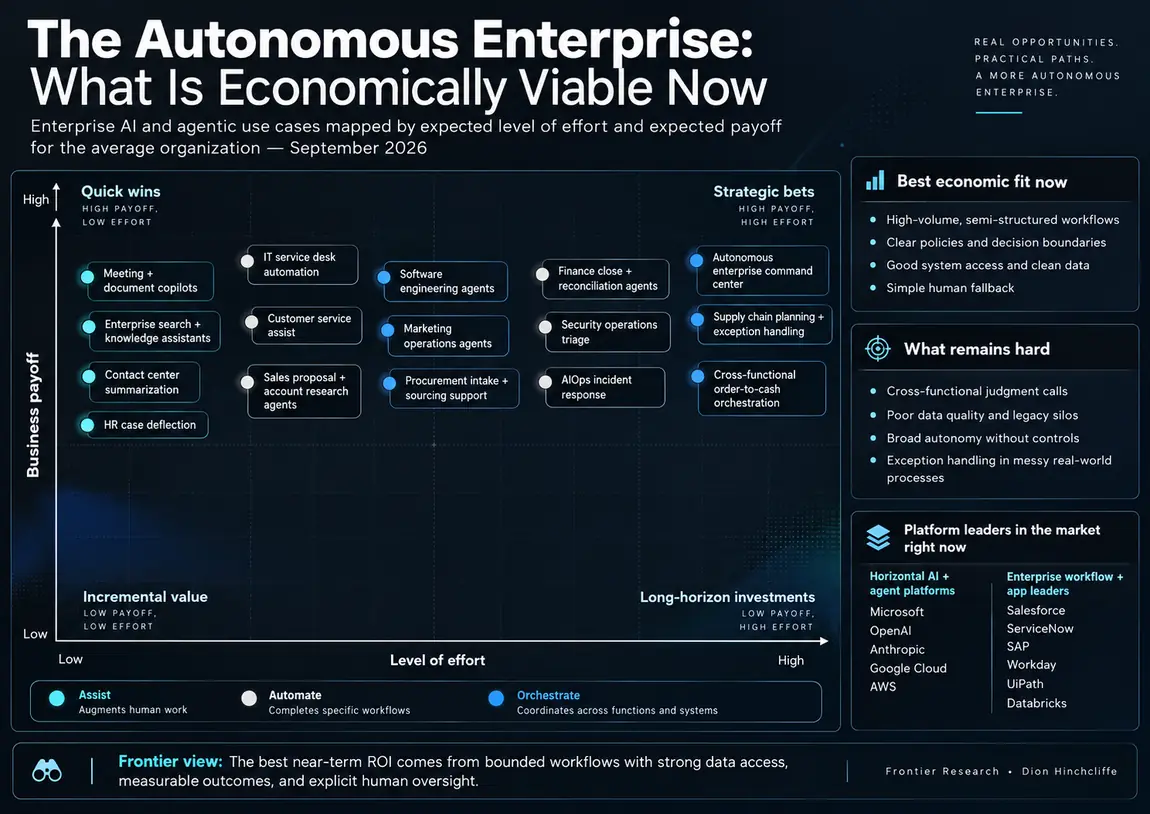
| Opportunity | Typical 2026 viability | Relative payoff | Relative effort |
|---|---|---|---|
| Meeting and document copilots | High | Medium | Low |
| Enterprise search and knowledge assistants | High | Medium | Low |
| Contact-center summarization | High | Medium | Low |
| HR case deflection | High | Medium | Low |
| IT service-desk automation | High | High | Low–medium |
| Customer-service assist | High | Medium–high | Medium |
| Sales proposal and account research | High | Medium | Medium |
| Software-engineering agents | High | High | Medium |
| Marketing-operations agents | Medium–high | Medium–high | Medium |
| Procurement intake and sourcing support | Medium–high | Medium | Medium |
| Finance close and reconciliation agents | Medium | High | High |
| Security-operations triage | Medium | High | High |
| AIOps incident response | Medium | Medium–high | High |
| Supply-chain planning and exception handling | Emerging | High | Very high |
| Cross-functional order-to-cash orchestration | Emerging | High | Very high |
| Autonomous enterprise command center | Emerging | Very high | Very high |
The message is not to avoid difficult domains. It is to sequence them. Organizations should harvest bounded, repeatable work first, while building the architecture needed to move into cross-functional autonomy.
The economics of autonomy
Agent economics differ from traditional software economics in an important way: the cost of a workflow remains dynamic after deployment.
Model selection, token use, context size, tool calls, retries, human review, exception rates, latency requirements, and run frequency all change the unit economics. A workflow that is unattractive today can become viable after model costs fall, routing improves, or exceptions are redesigned out of the process.
McKinsey’s August 2026 analysis makes the point especially clearly. In one customer-service example, token costs represented only 20% to 25% of variable run costs while human oversight represented 70% to 75%.4 The implication is profound: simply waiting for cheaper tokens does not solve the economics of autonomy. The real economic lever is reducing expensive human intervention without allowing error costs to explode.
That requires a different ROI model.
Frontier recommends measuring cost to completed work, not cost per token, agent, seat, or interaction. A completed outcome might be a resolved incident, closed account reconciliation, onboarded customer, processed claim, qualified lead, or replenished inventory exception. The denominator must be the business result.
A useful operating equation is:
Autonomy value = (human effort avoided + cycle-time value + quality lift + revenue or risk value) − (AI run cost + integration cost + oversight cost + error cost + governance cost).
This creates four practical design principles.
First, volume matters. Fixed implementation and governance costs amortize best over large pools of repeatable work.
Second, reuse matters. Common agent capabilities—research, document understanding, policy checking, reconciliation, outreach, scheduling, exception classification—should be reusable across workflows rather than rebuilt for each one.
Third, routing matters. The most capable model should not be the default model. Organizations need model and tool routing based on task difficulty, risk, latency, and cost.
Fourth, exceptions matter most. Every workflow has a point where uncertainty, authority, or risk requires a human. The percentage of cases crossing that boundary often determines whether the economics work.
The largest opportunity is therefore not “labor replacement.” It is work compression: fewer handoffs, less waiting, faster decisions, lower coordination cost, and higher capacity. McKinsey describes this as reducing the “coordination tax” embedded between functions and systems; its 2026 survey found widespread individual productivity gains but much less EBIT impact, highlighting how task productivity can fail to become enterprise value when workflows remain unchanged.5
BCG reaches the same conclusion from operating-model work: large gains appear when organizations redesign end-to-end processes around agentic execution instead of placing AI on top of existing workflows.6
Why autonomous enterprise programs stall
The most common failure mode is architectural optimism: an organization sees an impressive agent demonstration and assumes production autonomy is primarily a model-selection problem.
It is not.
Processes were designed for people
Most enterprise processes contain undocumented judgment, informal workarounds, handoffs, duplicate approvals, and tacit knowledge. Agents expose that debt immediately. Deloitte’s research found that only one in five leaders believes their organization is prepared to redesign processes for autonomous operation.3
Automating a poor process can make it faster without making it better. The more autonomous the system, the more dangerous that becomes.
Identity and authority are harder than intelligence
An agent that can reason but cannot safely authenticate, receive scoped authority, or prove what it did is not enterprise-ready.
NIST’s August 2026 guidance argues that agentic systems are repeating a familiar security pattern: shipping capability faster than identity foundations. It highlights the need to treat agents as attributable actors with strong authentication and authorization rather than as anonymous model calls.7
This means every production agent needs an owner, identity, permission boundary, credential strategy, allowed-tool set, audit trail, and revocation path. Standing broad credentials are the wrong pattern. Authority should be least-privilege, contextual, and time-bounded wherever possible.
Enterprise context is fragmented
Agents need more than retrieval. They need semantic context: which customer is meant, which product hierarchy applies, which policy is current, which source is authoritative, which metric definition the organization uses, and which transaction is canonical.
Knowledge graphs, semantic layers, master data, governed retrieval, and high-quality metadata become part of the execution architecture, not just analytics infrastructure.
Cross-functional autonomy has organizational owners
An agent can cross systems more easily than a company can cross silos.
Order-to-cash spans sales, legal, finance, operations, customer success, and often external partners. Supply-chain exception management crosses planning, logistics, procurement, finance, and manufacturing. Autonomous workflows force organizations to answer questions that traditional applications can avoid: Who owns the outcome? Who owns the agent? Who can change its policy? Who absorbs its errors? Who approves expanded authority?
Reliability must be measured continuously
Agents are probabilistic systems operating inside dynamic environments. Testing once before launch is inadequate.
Production autonomy requires evaluations, traces, replay, policy checks, anomaly detection, cost telemetry, outcome metrics, and controlled rollout. The appropriate unit is not merely model accuracy. It is reliable completed work within policy.
Gartner’s 2026 analysis warns specifically about overestimating agent reliability, agent sprawl, unmanaged token costs, weak data foundations, and insufficient change management.2
Architecture of an autonomous organization
The autonomous enterprise should not be designed as a single super-agent.
It is better understood as a governed mesh of domain agents, deterministic workflows, enterprise systems, people, and shared control services. Figure 2 shows the merged business and IT architecture.
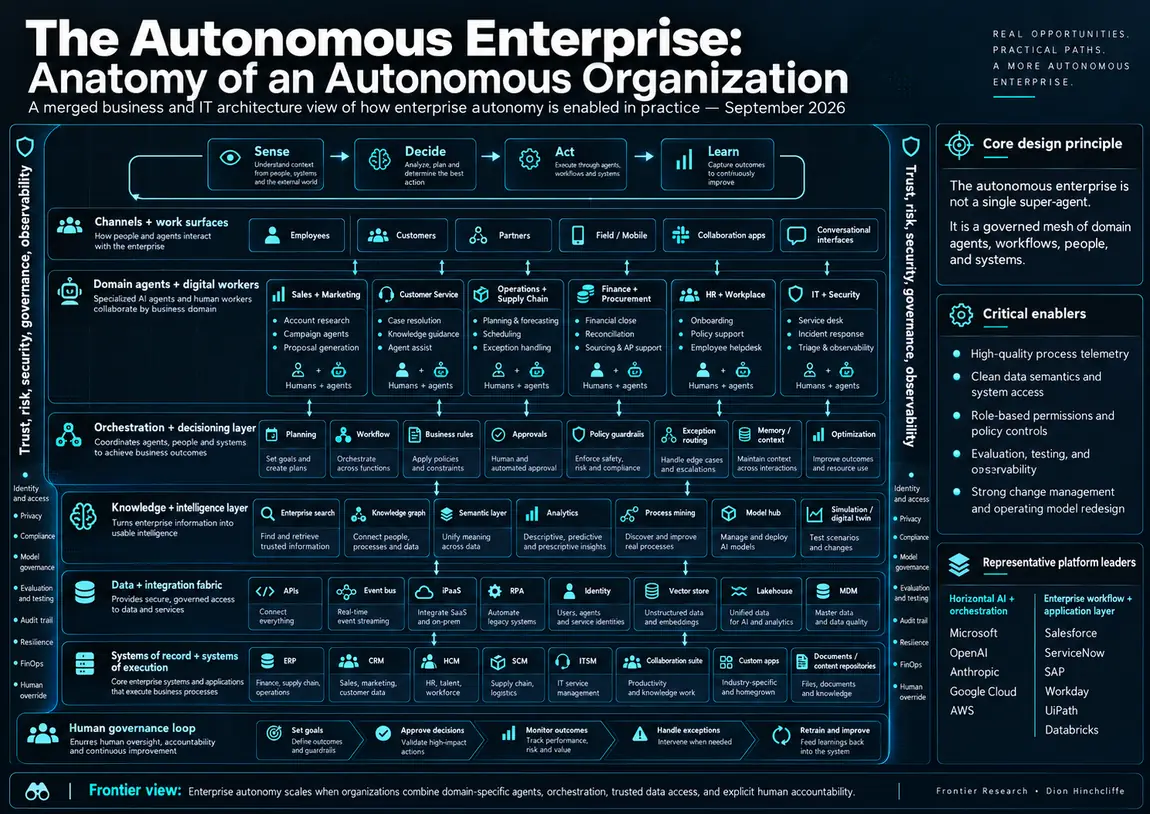
The architecture begins with a simple operating loop:
Sense → Decide → Act → Learn.
That loop is implemented through several layers.
1. Channels and work surfaces
Employees, customers, partners, field workers, collaboration tools, mobile applications, and conversational interfaces are where intent enters and outcomes return.
The goal is not to force every interaction through a chatbot. Autonomy should surface inside the work context where the user already operates.
2. Domain agents and digital workers
The most effective agents are increasingly specialized around a business domain or role: sales and marketing, customer service, operations and supply chain, finance and procurement, HR and workplace, IT and security.
This specialization is consistent with Gartner’s deployment evidence: domain-specific agents are easier to bound, evaluate, govern, and improve than a universal enterprise agent.2
3. Orchestration and decisioning
This is the critical middle layer.
It contains planning, workflow, business rules, approvals, policy guardrails, exception routing, memory/context, and optimization. It determines what an agent may do, when another agent or system should act, and when a person must intervene.
This layer is where autonomy becomes enterprise-grade. Without it, organizations have agents. With it, they begin to have an autonomous operating system.
4. Knowledge and intelligence
Enterprise search, knowledge graphs, semantic layers, analytics, process mining, model hubs, and simulation/digital twins turn organizational information into usable context.
This layer is increasingly strategic because agent quality depends on the quality, freshness, and semantics of the context presented at decision time.
5. Data and integration fabric
APIs, event buses, integration platforms, RPA, identity, vector stores, lakehouses, and master data management connect agents to the operational enterprise.
The key architectural shift is from “AI reads enterprise data” to AI participates in enterprise transactions. That requires transaction-safe interfaces, permission-aware access, idempotency, and observability.
6. Systems of record and execution
ERP, CRM, HCM, SCM, ITSM, collaboration suites, industry applications, and content repositories remain essential.
The autonomous enterprise does not replace systems of record. It changes their role. They become trusted transactional substrates underneath a more dynamic layer of agentic coordination.
7. The trust plane
Identity, security, privacy, compliance, model governance, evaluations, audit, resilience, FinOps, and human override must span every layer.
The emerging market confirms this architectural direction. Microsoft Agent 365 is explicitly positioned as a cross-agent control plane for discovery, identity, governance, security, and observability.8 AWS AgentCore places identity, gateway policy, runtime isolation, and observability around agents regardless of model or framework.9 ServiceNow’s AI Control Tower similarly emphasizes discovering, securing, governing, observing, and measuring agents across the enterprise.10
The architectural implication is clear: governance is moving from policy documents into the runtime path of autonomous work.
8. The human governance loop
Humans remain responsible for goals, high-impact approvals, exception handling, outcome monitoring, and changing the system.
This is not a temporary concession to immature models. It is the organizational control structure that makes scalable delegation possible.
The more capable agents become, the more important it is to define where human judgment is economically and ethically valuable rather than keeping people in every loop by default.
The platform battle is moving up the stack
The enterprise-agent market in 2026 is converging around several architectural control points: agent creation, orchestration, context, identity, tool access, governance, observability, evaluation, and domain execution.
No single vendor owns the entire stack, and most large organizations will remain multi-platform. What matters is where each vendor has native advantage.
| Vendor | Current center of gravity | Strategic significance |
|---|---|---|
| Microsoft | Copilot Studio, Foundry, Agent 365, Entra, Purview, Defender | Extends an existing enterprise identity, productivity, and security control plane to agents. |
| OpenAI | Frontier, Agents API, ChatGPT for Work | Combines frontier models with long-running agent execution, business context, evaluations, and enterprise governance. |
| Google Cloud | Gemini Enterprise Agent Platform | Full-stack agent development, runtime, identity, gateway, orchestration, model choice, and governance. |
| AWS | Amazon Bedrock AgentCore | Framework- and model-agnostic runtime, identity, gateway, policy, observability, and evaluation services. |
| Salesforce | Agentforce and Trusted Enterprise AI Harness | Strong customer/business context, action layer, and control plane around CRM-centric work. |
| ServiceNow | Autonomous Workforce and AI Control Tower | Strong position in workflow execution, IT/service operations, and cross-agent governance. |
| SAP | Joule, Autonomous Suite, SAP Business AI Platform | Deep advantage in governed ERP processes, business semantics, and transactional context. |
| Oracle | Fusion Agentic Applications and AI Agent Studio | Embeds coordinated agents directly in finance, HR, supply-chain, and CX transactions. |
| Workday | Sana agents and Agent System of Record | Treats agents as a managed digital workforce with identity, security, analytics, and auditability. |
| UiPath | Maestro and agentic automation platform | Bridges deterministic automation, agents, APIs, process design, and orchestration. |
| IBM | watsonx Orchestrate Agentic Control Plane | Emphasizes cross-agent operations, governance, cataloging, scheduling, and enterprise scale. |
| Anthropic | Claude, Claude Code, enterprise agent tooling | Strong reasoning and tool-use layer increasingly used as the intelligence substrate inside enterprise workflows. |
OpenAI’s September 2026 Agents API is a useful marker of where the model layer is heading: the product emphasis is no longer simply an inference call, but a managed harness that can maintain context, use tools, coordinate subagents, run for long periods, and persist intermediate work.11 OpenAI Frontier moves further toward an enterprise operating layer by combining business context, execution, evaluation/optimization, permissions, and auditing.12
Google’s Gemini Enterprise Agent Platform follows the same pattern, bringing model access, agent development, orchestration, Agent Identity, gateways, and governance into one platform.13
Salesforce now describes its Trusted Enterprise AI Harness as the common foundation that gives agents business context, planning capability, trusted action, and enterprise controls.14 SAP’s Autonomous Enterprise architecture similarly couples Joule, an Autonomous Suite, and a governed Business AI Platform around core business processes.15
Application vendors have a particular advantage where they already own transactional context. Oracle’s Fusion Agentic Applications operate inside Fusion security, workflows, policies, approval hierarchies, and transactions.16 Workday’s Agent System of Record centralizes discovery, registration, security, governance, analytics, and audit for a mixed human-and-agent workforce.17
Automation vendors are moving in the opposite direction—up from deterministic automation into agentic orchestration. UiPath Maestro now combines process modeling, APIs, automation, and agents, with September 2026 releases explicitly connecting process redesign to executable agentic workflows.18 IBM’s Agentic Control Plane similarly focuses on operating, governing, and scaling agents across enterprise environments.19
Anthropic illustrates another important market pattern: the model provider increasingly becomes an embedded enterprise reasoning layer rather than a standalone destination. Claude’s 2026 model releases emphasize autonomous tool use and longer-running work, while Anthropic’s enterprise work increasingly targets legal, finance, sales, coding, and other knowledge domains.20
The strategic consequence for CIOs is that the vendor decision is not “Which agent platform wins?” It is which control points must remain portable, which can be delegated to a strategic platform, and where native application context is worth accepting platform gravity.
How to enable the autonomous enterprise
Frontier recommends a staged enablement model.
1. Start with an autonomy portfolio, not an agent catalog
Inventory candidate workflows and score them on business payoff, execution volume, process variability, data readiness, integration effort, risk, exception rate, and measurability.
Do not begin by asking where to “use agents.” Begin with work that is expensive, slow, coordination-heavy, or constrained by scarce expertise.
2. Redesign the workflow before automating it
Map the current process, but do not preserve it by default.
Remove redundant approvals, eliminate unnecessary handoffs, expose hidden decision rules, define authoritative data, and specify exception paths. BCG’s 2026 work shows that end-to-end redesign is the dividing line between incremental task gains and much larger operating improvements.6
3. Define an autonomy envelope
For every production agent or agent team, specify:
- the outcome it owns;
- events that may trigger it;
- systems and data it may access;
- actions it may take;
- spending or transaction limits;
- decisions requiring approval;
- prohibited actions;
- escalation conditions;
- service-level objectives;
- evaluation thresholds;
- accountable human owner.
This is the executable contract of enterprise autonomy.
4. Make agent identity a first-class architecture domain
Every agent should be discoverable and attributable.
Create lifecycle management for registration, ownership, credentials, permissions, policy, monitoring, and retirement. Use delegated or workload identities instead of shared credentials. Apply least privilege and short-lived authority wherever the platform permits it.
NIST’s guidance makes this foundational rather than optional.7
5. Build a shared orchestration layer
Avoid hard-wiring every agent directly to every system.
Use a governed mediation layer for tools, workflows, rules, approvals, memory, exception routing, and inter-agent coordination. This is the point where heterogeneous agents can participate in consistent enterprise controls.
6. Treat enterprise context as production infrastructure
Create trusted retrieval, semantic definitions, knowledge services, metadata, and business context that agents can consume consistently.
Agentic systems magnify ambiguity. If three systems disagree about a customer, policy, product, or metric, autonomy makes the inconsistency operational.
7. Instrument everything
Trace prompts, plans, tool calls, policy decisions, transactions, exceptions, latency, model usage, costs, and business outcomes.
An enterprise should be able to reconstruct why a significant agent action occurred, what context was used, what policy allowed it, and what happened afterward.
8. Evaluate completed work continuously
Create test suites and production evaluations at three levels:
- task quality — did the agent perform the immediate task correctly?
- workflow quality — did the end-to-end process reach the desired outcome?
- enterprise quality — was the outcome compliant, economical, secure, and aligned with policy?
The third level is where enterprise autonomy succeeds or fails.
9. Make AI economics an operating discipline
Track cost per completed outcome, exception cost, human review time, model/tool spend, error cost, and realized business value.
Re-evaluate routing and workflow design regularly because the economics are changing rapidly. McKinsey argues that agentic unit economics should become part of recurring business reviews rather than a one-time business case.4
10. Create a human-agent operating model
Roles will change before org charts do.
Employees will increasingly supervise, direct, correct, and collaborate with agents. Managers will allocate work across humans and digital workers. Process owners will become autonomy owners. Security, architecture, data, finance, legal, and business operations will share responsibility for runtime policy.
This requires training, incentives, job redesign, and clear accountability—not merely tool adoption.
11. Design for multi-vendor autonomy
Assume that important business processes will include agents from application vendors, cloud platforms, model providers, automation suites, and internal teams.
Standardize identity, tool access, observability, evaluation, metadata, policy, and agent-to-agent interaction where possible. Avoid making the control plane inseparable from a single model.
12. Expand autonomy only when evidence supports it
Use progressive delegation.
Start with recommendation, move to human-approved action, then to bounded autonomous action, and finally to wider exception-based oversight when reliability and economics support it.
Autonomy should be earned empirically.
The CIO mandate changes
For decades, CIOs were responsible for systems that stored information, ran transactions, and enabled people to perform work.
The autonomous enterprise adds a new responsibility: systems that perform work themselves.
That turns several familiar disciplines into something larger.
Enterprise architecture becomes the architecture of human and machine agency.
Identity management expands from people and applications to digital workers.
Integration becomes tool access and action mediation.
Data governance becomes decision-context governance.
IT operations become the operations of probabilistic workers.
FinOps expands from cloud resources to machine cognition.
Cybersecurity moves from protecting applications to constraining autonomous actors.
Portfolio management expands from applications and projects to agents and delegated business capabilities.
And governance moves from periodic review to runtime control.
This does not reduce the importance of the CIO. It pulls technology leadership closer to the operating model of the company.
The most advanced organizations will eventually stop treating “AI agents” as a separate technology category. They will become one execution resource among several: people, deterministic software, robots, APIs, and autonomous digital workers.
The enduring architectural question will be simple:
Who—or what—should perform this work, with what authority, under which controls, at what economics?
Frontier outlook
The autonomous enterprise is not a 2030 concept. Important pieces are production-ready now.
But autonomy will arrive process by process, not company by company.
The organizations that move fastest will not be those that declare the broadest autonomous ambitions. They will be those that develop a repeatable institutional capability to find economically attractive work, redesign it, expose reliable context, assign bounded authority, observe execution, measure completed outcomes, and progressively delegate more.
That creates a flywheel.
Each successful workflow produces reusable agents, tools, policies, context, integrations, evaluations, and operating knowledge. Those assets lower the cost and risk of the next autonomous workflow. Over time, autonomy compounds.
That is the real strategic opportunity.
The autonomous enterprise is not one large act of automation. It is the accumulation of thousands of well-governed delegations.
[^mckinsey-state-2026][^gartner-agentic-roi][^deloitte-readiness-2026][^mckinsey-agent-economics-2026][^mckinsey-coordination-2026][^bcg-ai-operations-2026][^nist-agent-identity-2026][^microsoft-agent365-2026][^aws-agentcore-2026][^servicenow-control-tower-2026][^openai-agents-api-2026][^openai-frontier-2026][^google-agent-platform-2026][^salesforce-harness-2026][^sap-autonomous-enterprise-2026][^oracle-agentic-apps-2026][^workday-asor-2026][^uipath-maestro-2026][^ibm-control-plane-2026][^anthropic-sonnet5-2026]Push this further.
Bring us the question. We’ll take it further together.