The Future of Work in the AI Era
AI is not just accelerating work. It is dismantling the old division of labor. Workers will direct agent swarms, pursue original R&D with frontier models, and engineer missions rather than tasks. The CIO's challenge: capture the upside without leaving people behind.
Take the argument with you.
Read the publication-ready report or watch the rapid-fire Frontier briefing. Both are generated from the canonical Research Object.
Executive perspective: the organization is now the bottleneck
AI is acquiring a different place in the productive life of the enterprise. Yesterday the employee operated software. Today the employee uses AI to think and create alongside software. Tomorrow the employee increasingly commissions work from coordinated machine capabilities, monitors evidence, and decides where human judgment must intervene. This is a change in the unit of management: from individual tasks and application seats to missions, delegated execution, verified outputs, and organizational learning.
The opportunity is real, but it is neither frictionless nor evenly distributed. A peer-reviewed study of 5,172 customer-support agents found that AI assistance increased issues resolved per hour by 15% on average, with gains concentrated among less experienced workers.1 A randomized experiment across 66 organizations and 7,137 knowledge workers found that active users of an integrated AI assistant spent approximately two fewer hours per week on email, but it did not detect broader task-reallocation effects from individual access alone.2 In a field experiment at Procter & Gamble, individuals assisted by AI matched the performance of conventional two-person innovation teams on the studied challenges.3 Conversely, an experiment with 758 consultants found 25.1% faster completion of tasks inside AI's capability frontier, yet participants were 19% less likely to solve a deliberately selected task outside it correctly.4
These findings are not contradictory. They describe a capability with a jagged performance frontier inside organizations that are largely still structured for human execution. Productivity gains inside tasks do not automatically remove handoffs, resolve conflicts, release investment, improve customer outcomes, or create enterprise value. McKinsey's 2025 global survey found that respondents at AI high-performing organizations were substantially more likely to report fundamental workflow redesign (55% versus 20% elsewhere); this is correlational survey evidence, not a causal effect size.5
The deepest change is not that a machine can draft a memo. It is that a small group can now investigate ideas, build prototypes, exercise software, synthesize evidence, and operate bounded workflows at scales once reserved for specialized departments. The worker gains extraordinary agency—and a new burden of specifying, validating, and taking responsibility for what happens. The CIO has to build the conditions that make this productive and humane rather than chaotic and extractive.
1. The worker journey: seven transitions in how work gets done
The worker's path is neither a straight line nor a maturity ladder every person must climb. A laboratory scientist, a branch manager, a developer, a nurse, and an executive will adopt different forms of AI. The useful common arc is use → collaborate → delegate → orchestrate → engineer outcomes. Throughout that arc, employees must be able to understand the evidence, contest a machine recommendation, retain agency over consequential decisions, and acquire skills that remain marketable outside any single vendor ecosystem.
Stage 1: Relief. An employee uses an assistant to summarize correspondence, translate, reformat, research, draft, analyze, and prepare for meetings. The immediate win is reduced friction. The trap is measuring value in generated words or self-reported hours saved instead of quality and the disposition of the time released. The six-month 66-firm experiment demonstrates the trap clearly: email time fell for users, but enterprise tasks did not visibly reorganize.2
Stage 2: Partnership. AI becomes a sparring partner rather than a text expander: the employee asks it to challenge assumptions, simulate objections, compare designs, and teach unfamiliar domains. The worker learns to map the jagged frontier: when the model helps, when it confidently fails, and when an independent source or expert is mandatory.4
Stage 3: Delegation. The employee assigns bounded, multi-step assignments to agents with tools and explicit acceptance criteria. The new skill is delegation design: write the task, supply context, specify limits, provide reversible tools, demand a trace, and inspect the result. METR's measurements suggest longer autonomous software tasks have been becoming feasible, but benchmark time horizons cannot be read as reliable automation of complex real-world jobs.6
Stage 4: Orchestration. The worker coordinates specialist agents and people against a common objective, deciding what may run in parallel and where separation of duties is required. More concurrent agents can also produce correlated hallucinations, duplicate actions, resource contention, and false confidence. The worker becomes an editor of an execution system, not its fastest typist.
Stage 5: Mission ownership. A professional defines an outcome, turns it into verifiable conditions, chooses architecture and constraints, directs agents, proves completion, and is responsible for residual risk. That is Mission Engineering, the operating discipline developed in Frontier's October 15 analysis of AI-first software work.7 It extends well beyond IT: a mission can be claims resolution, reducing industrial defects, processing a clinical referral, or accelerating the discovery cycle of a scientific team.
Stage 6: Institutional reinvention. Teams stop treating generated outputs as isolated shortcuts. They redesign decision rights, accountabilities, interfaces, learning loops, and economic measures around what human-machine combinations can actually accomplish. This is the threshold at which organizations—not only individuals—become more productive.
Stage 7: Renewed human differentiation. The ultimate human contribution concentrates in framing problems, forming trust, deciding what matters, building relationships, exercising moral judgment, challenging evidence, and making the organization worthy of employee and customer confidence. The fact that execution can be delegated does not mean accountability can be outsourced.
2. What is actually new: a near-term capability map
The near-term opportunity comes from the convergence of several capabilities rather than one magical model: multimodal understanding and communication; advanced reasoning and extended context; tool-using agents; structured retrieval over proprietary data; code and interface generation; machine-scale synthesis and simulation; model routing and cheap inference; and continuous evaluation/observability. Stanford's 2026 AI Index documents rapid progress on certain tasks while highlighting striking weaknesses on deceptively simple challenges: its summary reports OSWorld agent success near 66% in 2025, not universal reliability.8 The discrepancy between spectacular benchmark capability and fragile real-world action is precisely why design discipline matters.
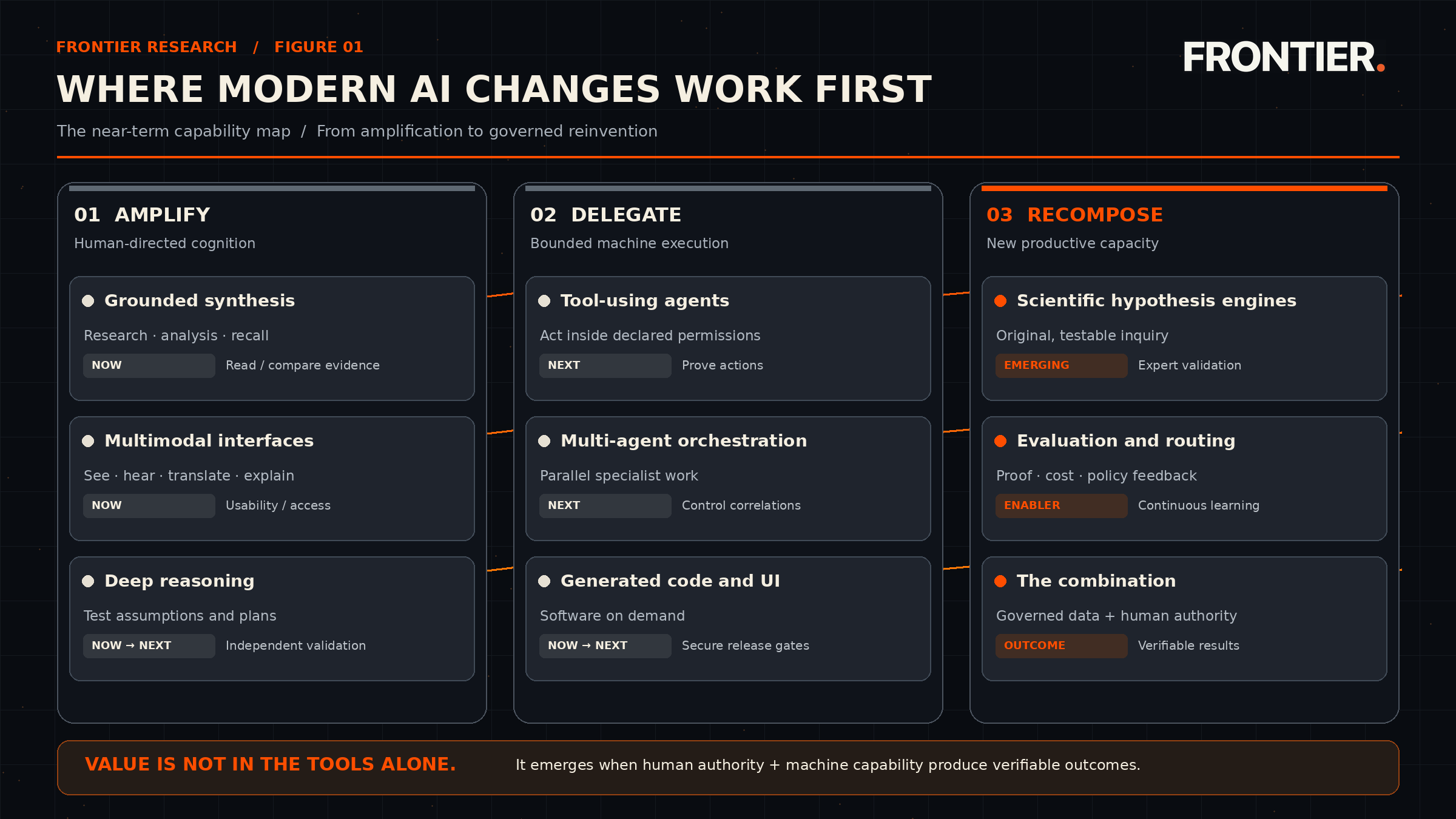
FIG. 01 — Modern AI capabilities by near-term transformative potential and enterprise readiness. Positions are Frontier analytical judgments, not vendor performance scores. The strongest opportunities emerge where several capabilities combine around a verifiable business problem.
Capability alone is not authority. A model that reads a screen is not automatically authorized to alter a bank record. A science agent that proposes a new mechanism has not demonstrated that mechanism experimentally. A generated application that appears correct has not proved its security, accessibility, or business semantics. CIOs must separate what the model can generate, what the system can verify, and what the enterprise permits it to do.
3. Seven new ways of working
I. Cognitive exoskeletons: every worker gets leverage
New possibility. Employees obtain always-available assistance with synthesis, explanation, document production, analysis, cross-language communication, and personalized task scaffolding. The most important effect may be expertise diffusion: a worker can benefit from accessible patterns of competent practice without waiting for a scarce specialist. The customer-support research found disproportionate gains among less experienced workers and evidence of workplace learning, although top performers experienced smaller benefits and some quality trade-offs.1
New operating model. Give every employee a governed personal workbench connected to approved knowledge, with identifiable sources, private workspaces, and explicit red lines for sensitive decisions. Measure correct work completed and learning gained, not prompts sent. Retrain managers to avoid treating faster first drafts as permission to increase workloads indefinitely.
Failure mode. Low-quality uniformity, automation bias, data leakage, deskilling, and invisible AI-generated errors embedded in professional judgments. Preserve the employee's right—and responsibility—to disagree with the system. Ease of adoption: low-to-moderate.
II. Agent swarms: the professional becomes an orchestra conductor
New possibility. Instead of one assistant following a single thread, a human supervises multiple specialist agents—researcher, analyst, engineer, tester, procurement negotiator, compliance reviewer—working in parallel or through controlled handoffs. Multi-agent architectures can generate and debate hypotheses; the 2026 peer-reviewed Co-Scientist paper provides a concrete research example with experimental validation in specified biomedical settings.9
New operating model. A mission owner specifies an outcome and acceptance rules; an orchestrator decomposes work; agents execute against least-privilege tools; an independent verifier checks evidence; a human approves exceptions and irreversible action. Implement budgets for tokens, wall-clock duration, API calls, and external transactions. Maintain an auditable event trail and a kill switch.
Failure mode. Swarm scale magnifies correlated failure, cascade errors, token spending, and authority creep. Independent-looking agents are not independent evidence if they share the same model, data, or flawed assumptions. Adoption difficulty: high.
III. Mission Engineering: intent in, evidence out
New possibility. Design and delivery cease to be organized around manually producing implementation artifacts. A Mission Engineer translates a desired business result into measurable requirements, a target architecture, enforceable guardrails, work packages, test oracles, and a proof of completion. Autonomous execution capacity performs reversible implementation and operations under bounded permissions. This is an expansion of classic systems engineering, outcome management, product thinking, site reliability engineering, and mission assurance—not a renamed prompt engineer.7
New operating model. Use an explicit mission contract: (1) business outcome and accountable owner, (2) service and quality constraints, (3) data and permission boundaries, (4) acceptable evidence, (5) budget and stopping rules, (6) rollback and escalation. Software, QA, SRE, security, operations, and business specialists become a coordinated mission team. The source code, runbook, workflow, or app is an intermediate artifact. The deliverable is a verified operating capability.
Failure mode. An elegant demo can be deeply wrong; generated code may bypass the controls that normally detect defects. METR observed experienced developers completing familiar repository tasks 19% slower with early-2025 tools, despite believing they were faster.10 DORA's 2025 research likewise describes AI as an amplifier of preexisting organizational conditions.11 The implication is not to stop generating code. It is to engineer independent tests, secure sandboxes, provenance, policy-as-code, operations telemetry, and expert sign-off into the execution path. Adoption difficulty: very high because it changes power, roles, and accountability.
IV. Frontier R&D engines: original problem-solving at new scale
New possibility. Top reasoning models and co-scientist systems help workers generate conjectures, connect previously distant literatures, formulate experiments, explore causal mechanisms, model candidate designs, and disprove weak ideas. The change is not merely faster literature review; it is an expanded search space for original hypotheses. In May 2026, a Nature paper reported real-world experimental testing of multi-agent-generated biomedical hypotheses in drug repurposing, target discovery, and antimicrobial resistance.9 This is serious evidence of potential, but not proof that an arbitrary frontier-model answer is a discovery.
New operating model. Build a research loop: objective → literature/evidence graph → diverse hypotheses → skeptical cross-examination → prioritization → reproducible computational experiment → independent laboratory or operational validation → decision record. Keep a human domain expert responsible for falsification strategy. Treat model disagreement as a source of inquiry, not a vote. For non-scientific organizations, use the same method for product design, logistics, fraud patterns, policy interventions, service innovation, and operational experiments.
Failure mode. Plausible novelty that recycles known work, unverifiable citations, simulated results mistaken for empirical observations, intellectual-property ambiguity, and experiments that optimize an irrelevant proxy. A frontier model can improve the design of a test; only real evidence can close it. Adoption difficulty: high to very high, particularly where experiments are costly or regulated.
V. Infinite capability factories: generate software around work
New possibility. Workers describe the capability required and receive generated scripts, interfaces, automations, data transformations, internal applications, and workflow-specific tools. Software becomes a more elastic expression of intent, while authoritative records, identity, semantics, and controls remain durable. This extends Frontier's earlier analysis of the “Infinite SaaS Factory” and the changing boundaries of enterprise applications.12
New operating model. Provide approved composable APIs, tested data products, secure build sandboxes, generated-test pipelines, an application/agent inventory, versioning, accessibility checks, and expiry policies for temporary capabilities. Track the software tail being created: even cheap code incurs monitoring, cybersecurity, support, integration, and retirement costs. Curate reusable components rather than allowing every employee to establish a hidden software estate.
Failure mode. A proliferation of unsafe micro-applications can recreate shadow IT at machine speed. More software is not more productivity if governance cost outpaces use. Adoption difficulty: moderate for prototypes, high for production work.
VI. Continuous decision intelligence: from reporting to tested choices
New possibility. Knowledge workers can interrogate enterprise telemetry conversationally, generate scenario trees, evaluate alternatives, identify weak signals, and continuously challenge assumptions. A CFO can test demand and cost scenarios; a supply-chain lead can explore supplier failures; a CIO can simulate capacity, resilience, and vendor concentration. The key transformation is not prettier dashboards but a shorter path from evidence to a reversible decision.
New operating model. Combine governed data, semantic metrics, causal assumptions, simulation, uncertainty intervals, and explicit human decision rights. Require citations to actual data and distinguish descriptive findings, predictive estimates, and proposed interventions. Log what decisions were made and whether the predictions held. The enterprise should learn from its forecasts rather than preserve the illusion that every AI recommendation was correct.
Failure mode. Confident but invalid causal claims, poorly calibrated forecasts, dashboard laundering, and automated decision loops that turn biased historical data into policy. Prioritize reversible, decision-supporting applications before high-consequence autonomy. Adoption difficulty: moderate.
VII. Adaptive teams and learning organisms: redesign the human network
New possibility. AI makes expertise more transferable, enables personalized training and rehearsal, surfaces adjacent skills, and supports temporary cross-functional mission teams. The P&G field experiment suggests that an individual with AI can reproduce some advantages of a conventional multidisciplinary pairing on the studied innovation tasks.3 Microsoft's 2026 Work Trend Index documents employee agency and work reorganization as central themes, though its telemetry and surveys should be treated as provider-associated evidence.13
New operating model. Build continuous learning into paid work; provide AI apprenticeships, simulation-based practice, peer review, role-based certifications, and explicit career pathways. Reward mentorship and knowledge transfer. Preserve junior pathways: early-career professionals must still learn how to recognize bad work, not merely supervise outputs they cannot judge. The WEF's 2025 employer survey expects 39% of workers' existing skills to change or become outdated by 2030.14
Failure mode. The apprenticeship collapse. Stanford's August 2026 payroll analysis found no widespread economy-wide AI displacement, but workers ages 22–25 in more exposed occupations were roughly 19% below the employment they would have had if they had kept pace with less-exposed peers; the authors identified reduced hiring as an important channel.15 That estimate is observational, not proof that AI alone caused the gap. Nonetheless, stripping entry-level work of learning opportunities while retaining senior-dependent verification is an economically self-defeating design. Adoption difficulty: very high because compensation, promotion, identity, trust, and work allocation must change together.
4. From seven transformations to one operating system
The seven modes are complements, not separate procurement categories. Cognitive exoskeletons expand an employee's reach. Agent swarms provide delegated capacity. R&D engines widen the possibility frontier. Generative software turns ideas into prototypes and infrastructure. Decision intelligence closes feedback loops. Adaptive teams change the speed at which people learn. Mission Engineering is the integrating discipline that converts all six into governed, verifiable outcomes.
The enduring architecture has five layers: intent (business purpose and measures), human authority (owners and rights), intelligence supply (models, agents, data, tools, expertise), execution and evidence (sandboxes, workflows, tests, monitors), and learning (measured outcomes, incidents, redeployment). Enterprises should not buy a single product and assume these layers appear. They should ensure each can be independently examined and replaced.
Policy must operate in the runtime path, not solely as a PDF. NIST's Generative AI Profile provides risk-management concepts; EU AI literacy obligations apply to providers and deployers, with a July 2026 regulatory amendment affecting Article 4 context.1617 These are distinct from authority to automate a particular job or regulated decision. A control system must be able to say no to a machine, produce evidence for the refusal, and support a rapid human appeal.
5. Quantifying impact: a decision model, not a manufactured forecast
Claims of “30% workforce productivity” are meaningless without a denominator, causal counterfactual, quality adjustment, and a clear conversion mechanism. Frontier proposes measuring quality-adjusted capacity released first, then separately measuring value captured, revenue produced, customer quality, working conditions, and actual financial benefit. A credible CIO business case uses matched control groups or staggered rollout; unit-of-work baselines; blinded evaluation where feasible; and monitoring of rework, exceptions, failure cost, security, and employee experience.
An illustrative 1,000-person knowledge-intensive organization. Assume 1,680 productive hours per person/year, or 1.68 million annual hours. Partition work into seven nonoverlapping task pools, plus an excluded 12% of work not suited to these interventions in the near term. The seven pools are 23% personal knowledge work, 17% delegable process work, 11% engineering/mission delivery, 8% R&D/discovery, 8% generated tools, 13% decision/analysis, and 8% teaching/collaboration. Those shares are assumptions for a worked example, not population measurements.
For each pool, estimate (a) adoption among relevant work, (b) net time saved on the adopted task after correction and verification, and (c) the portion of that time the organization can actually redeploy. Sum across mutually exclusive pools and subtract incremental coordination, governance, and recovery burden. Formula:
Net capacity share = Σ [work share × adoption × task-time improvement × capture] − shared operating overhead.
A base-case assumption set—adoption rates of 30–75%, within-task improvement 20–35%, and capture 45–65% depending on mode—produces 7.38% gross released capacity. After 1.5 percentage points of operating overhead, this is 5.88% net, or approximately 98,900 hours / 59 full-time-equivalent years. The latter is a unit of capacity, not a proposed headcount reduction or accounting saving. At a purely illustrative fully loaded €75/hour, it represents €7.4 million of annual labor-capacity equivalence, not €7.4 million of cash savings. If 35% is demonstrably converted into measurable P&L improvement, the equivalent would be roughly €2.6 million before platform, training, governance, and transition costs. A hypothetical €1.8 million annual program cost would leave approximately €0.8 million measurable contribution. These currency assumptions are not forecasts or universal benchmarks.
| Scenario | Net capacity released | Annual hours | FTE-year equivalents | What the scenario assumes |
|---|---|---|---|---|
| Cautious | 2.4% | 40,320 | 24 | Friction, narrow adoption, and weak capture |
| Base | 5.9% | 98,784 | 59 | Measured redesign, managed rollouts, 1.5 pp overhead |
| Accelerated | 12.6% | 211,680 | 126 | High trust, broader adoption, robust data/control foundations |
These are transparent Frontier sensitivity scenarios, not survey estimates or predictions. The headline result must be reported with confidence intervals, actual measurement periods, intervention costs, a task-mix adjustment, and adverse effects. Value will vary wildly by sector: legal drafting, production engineering, clinical care, and physical maintenance have different eligibility, review burdens, and ethical constraints.
Avoid double-counting. The same hour cannot be “saved” by a copilot, a swarm, and mission engineering simultaneously. Do not multiply three vendor productivity claims. If an automated process shifts effort to customer handling, measure the downstream constraint. If speed expands demand, measure incremental throughput instead of assuming labor removal. If employees complete more work but are exhausted or anxious, count that as a cost. If a tool produces higher quality at unchanged time, represent quality separately, not as imaginary saved hours.
Investment logic. Put 10–20% of early program spend into platform/model selection and orchestration, 20–30% into data, integration, security, and evaluation, and at least half into work redesign, education, management, incentives, and measurement as a planning heuristic to test, not a universal optimum. Verify that your own constraint is indeed organizational before extrapolating this ratio. The real return will usually come from better service levels, faster experiments, increased decision throughput, and avoided errors as well as direct efficiency.
6. Adoption map: technological ease is not organizational ease
Adoption difficulty rises when an intervention changes decision rights, carries irreversible impact, requires deep integration, demands independent proof, or threatens occupational identity. Therefore, a personal assistant can be easy to deploy but hard to turn into enterprise profit; a complex mission platform can be technically feasible but politically and culturally difficult.
Low friction / near-term: grounded personal assistance; approved meeting/document analysis; language accessibility; supervised drafting; self-paced learning. Success condition: secure access, training, and measurement of rework/quality. Failure condition: unconstrained data leakage or making “AI use” itself a performance target.
Moderate: decision intelligence with governed metrics; task-specific generated tools; bounded process agents; customer-service assistance; personalized role-based development. Success condition: reliable data, tool permissions, source provenance, named owners, and a service desk for failures. Failure condition: unmanaged shadow apps and enthusiastic projections unsupported by outcome measurement.
High: multi-agent workflow orchestration; AI-powered original R&D; production software generation; cross-functional mission teams. Success condition: sandboxing, eval gates, incident response, budget limits, expert review, and multi-quarter business sponsorship. Failure condition: correlated agent errors, hidden complexity, invalid scientific claims, or a breakdown in human escalation.
Very high / structural: Mission Engineering as the default delivery model; policy-governed autonomous operations; organization-wide redeployment; changing career ladders and performance economics. Success condition: redesigned management, collective bargaining/social dialogue where applicable, new professional qualifications, independent assurance, and board-level accountability. Failure condition: executives announcing automation goals without credible worker pathways or architecture for trust.
Adoption should therefore follow reversibility and verifiability, not model hype. A highly reversible task with good objective tests is often a better early automation candidate than an apparently simpler but ambiguous managerial decision.
Vendor evidence: where the new operating model is becoming tangible
Microsoft — the organizational readiness gap, not another Copilot adoption metric. Microsoft's 2026 Work Trend Index draws on a survey of 20,000 AI-using knowledge workers in ten markets, alongside Microsoft 365 usage telemetry. Sixty-six percent of respondents said AI freed time for higher-value work, and 58% reported producing work they could not have produced a year earlier. Yet only 19% were classified as having both high individual AI capability and organizational readiness; 10% had strong personal capability but were blocked by their organizations. Microsoft's modeling associated organizational factors with roughly twice the reported impact of individual factors. This is self-reported, vendor-associated research—not a causal estimate—but it strongly reinforces the hypothesis that manager capability, workflows and governance determine whether personal AI proficiency translates into institutional advantage.13 Microsoft Viva's employee-experience and learning surfaces are relevant here as mechanisms for understanding organizational signals and delivering training, not proof that deploying Viva causes productivity gains. The CIO should demand controlled evaluations of Copilot, Viva learning interventions, and workflow redesign together, rather than accept usage charts as an outcome measure.
Google — cross-application orchestration and the context problem. In September 2026, Google described Gemini capabilities that can orchestrate work across Gmail, Drive, Docs, Sheets, Slides and Chat using selected or administrator-permitted organizational context. In October, Google Cloud outlined enterprise agent tools, skills and registries connecting existing business applications and databases. These are concrete signs that the unit of automation is expanding from document assistance to bounded cross-system execution. They are vendor capability descriptions, not independently measured enterprise productivity effects. The test for CIOs is whether these integrations preserve source permissions, identity boundaries, data lineage, approvals and reproducible results across applications.1819
Salesforce — from agent activity to accepted work units. Salesforce describes Agentforce, Slack, Tableau and its API layer as a coordinated environment for human-agent operations, and reports internal support resolutions and annualized savings. Those figures are company-reported, lack a controlled counterfactual, and should not be projected onto another enterprise. Their significance is the attempt to measure completed business work rather than generated text or agent invocations. CIOs should adopt the measurement principle but independently audit acceptance, escalation, customer experience, rework and fully loaded operating cost.20
Across all three, the signal is architectural convergence: AI is moving into the systems that coordinate work, authorize actions and record outcomes. The competitive question is no longer who provides the best chat window. It is who can prove that delegated intelligence produces better results without weakening accountability, human agency or portability.
7. The human problem is the central engineering problem
Employees will interpret AI transformation through six questions: Will I still have a job? Will the work remain meaningful? Can I learn this? Can I challenge the machine? Who is liable when it fails? Will management share the gains? A credible transformation program must answer all six with observable practices, not slogans.
The biggest change-management error is to make employees bear the learning costs while managers capture all the savings. The second is to automate junior work without rebuilding the apprenticeship ladder. The third is to impose tool adoption without making space for practice, verification, and failure. The fourth is allowing agents to monitor and intensify labor in ways that remove autonomy, privacy, or professional dignity. The fifth is giving AI-produced recommendations the appearance of managerial neutrality: a model can inherit institutional bias and make it harder to contest.
Treat organizational trust as a measurable capacity. Establish a worker AI compact: clear purpose and permitted uses; confidential upskilling support; paid practice time; human appeal for consequential decisions; transparent surveillance boundaries; ergonomic workload constraints; employee participation in design; escalation channels for unsafe automation; and explicit internal mobility pathways. Build learning ladders from novice AI operator to domain-informed reviewer, agent supervisor, mission owner, and assurance leader. Reserve real diagnostic and design work for apprentices instead of assigning all easy cases to AI.
Managers have to change before employees can. A manager who has never run an agent, examined a failure trace, or set a stop condition cannot competently evaluate AI-era performance. Require hands-on executive and middle-management labs. Teach not only prompting but delegation, falsification, probabilistic quality, risk negotiation, task decomposition, and evidence-based appraisal. Training completion is not competence; certify people on realistic work and exception cases.
The labor outlook requires honesty. The ILO estimates roughly one in four workers is in an occupation with some generative-AI exposure, and emphasizes transformation rather than automatic redundancy.21 The WEF survey forecasts substantial skill change, while Stanford's 2026 payroll evidence raises a serious concern about hiring pathways for younger workers in exposed occupations.1514 Some roles will shrink. Others will emerge. There is no basis for promising no displacement or predicting one universal employment outcome. Fair process, early warning, retraining, and real redeployment are both ethical obligations and operational safeguards against losing indispensable knowledge.
8. CIO roadmap: four gates over 24 months
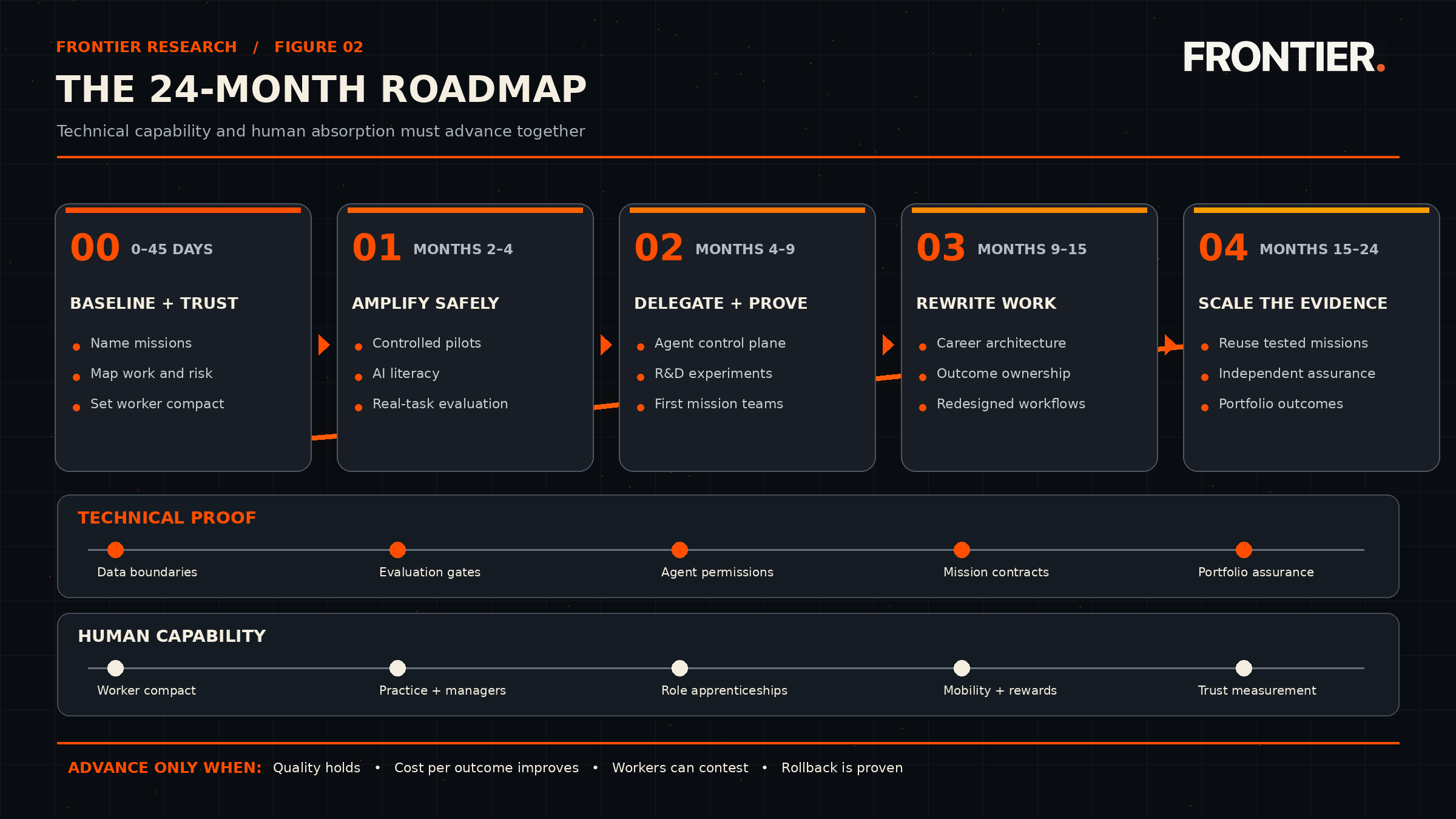
FIG. 02 — Frontier's 24-month roadmap. The two horizontal tracks move together: technical authority/evidence and human adoption/organizational absorption. Expansion is gated by measured results, not the calendar.
Gate 0 — Days 0–45: establish truth, trust, and sponsors. Convene CIO, CHRO, COO, CFO, security, legal/privacy, employee representatives, and two business operating leaders. Publish the worker AI compact before deployment. Inventory existing AI use and shadow agents. Map tasks by verifiability, harm, volume, dependency, and reversibility. Capture pre-intervention baseline for cycle time, quality, error/rework, service levels, employee sentiment, and cost per outcome. Identify three business missions, deliberately including one frontier R&D case and one conventional operational workflow. Gate: named accountable owners, permissible data boundaries, and measurable controls.
Gate 1 — Months 2–4: scale individual capability safely. Establish approved models and a common AI workbench. Build manager labs and job-specific learning paths. Run randomized or stepped-wedge pilots for selected roles with blinded output evaluations when practical. Launch decision-support and co-drafting interventions with read-only integrations. Make “time saved” subordinate to quality and employee well-being. Gate: demonstrable quality-adjusted benefit, adoption by task, security controls, and evidence of worker understanding.
Gate 2 — Months 4–9: delegate bounded work and build the mission platform. Provide agent identity, tool privileges, secret isolation, structured logs, model routing, continuous evaluations, budget ceilings, and intervention/rollback. Introduce small agent swarms only where independent review is demonstrable. Pilot Frontier-model R&D with preregistered hypothesis tests and expert falsification. Pilot software generation inside CI/CD gates. Form Mission Engineering teams around two reversible business outcomes. Gate: successful end-to-end transactions, audited exceptions, credible unit economics, and measured worker progression.
Gate 3 — Months 9–15: redesign management and economic accountability. Give cross-functional mission owners authority over outcomes, budgets, evaluation rules, and safe delegation. Rework scorecards and career architecture; create mission engineer, verifier, agent operations lead, and domain evaluator pathways. Connect R&D, generated software, and decision intelligence to operational datasets. Negotiate vendor portability, machine identities, invocation rights, and outcome-based pricing. Expand only proven patterns. Gate: sustained quality, no hidden risk migration, outcome economics better than baseline, and demonstrable trust among affected workers.
Gate 4 — Months 15–24: industrialize verified intelligence. Shift from isolated pilots to a governed portfolio of mission contracts, reusable agents, evaluation suites, data products, and worker skills. Embed continuous benefit measurement, incident learning, cost-quality routing, and periodic model replacement. Increase autonomy only by earned reliability and reversibility tiers. Produce board reporting across capacity, growth, quality, trust, reskilling, incidents, and deployment speed. Gate: independent assurance and measured business value over multiple periods.
The four gates are logical dependencies, not promises of delivery dates. A regulated insurer or public-sector agency may require an additional year for high-consequence autonomy. A software-intensive firm with strong engineering platforms may proceed faster. Never let the technical track outrun the workforce and evidence track.
9. The CIO's operating dashboard
Replace anecdote with a compact, auditable scorecard: (1) quality-adjusted cost per completed outcome, (2) elapsed time from intent to verified result, (3) percentage of eligible work redesigned end-to-end, (4) agent action success after independent verification, (5) serious incident rate and mean time to rollback, (6) percentage of tool calls inside declared policy, (7) human review load and exception escape rate, (8) total intelligence spend and cost per accepted output, (9) time redistributed to higher-value work, (10) employee agency/trust and workload, (11) role transition and internal mobility, (12) junior apprenticeship quality and hiring, and (13) evidence-backed innovation yield—the proportion of R&D hypotheses surviving real validation.
Report distributions, not simply averages. Newer employees, less fluent speakers, expert specialists, frontline staff, disabled workers, and managers may experience different effects. Track results against pre-registered control groups and watch for deteriorating quality while apparent speed improves. A material increase in output accompanied by falling customer trust, rising error costs, or unsustainable attention demand is not success.
10. What not to do
Do not equate task exposure with automatic job replacement. Do not multiply vendor efficiency figures across overlapping tasks. Do not measure prompt volume as productivity. Do not treat simulated experiments as scientific discoveries. Do not give agent swarms shared privileged credentials. Do not confuse dozens of AI personas with genuine independent corroboration. Do not replace secure systems of record merely because interfaces can be generated. Do not outsource ethical decisions to a model. Do not turn middle managers into compliance police for AI tool adoption. Do not remove junior opportunities and then wonder why expert judgment becomes scarce. Do not skip rigorous evaluation because a machine-produced demo looks convincing. And do not make employees pay the price of an organizational transition that leadership has not learned to lead.
Conclusion: engineering the right to delegate
The old organizational model assumed that execution capacity was scarce, software difficult to build, expertise slow to transfer, and workers best managed through tasks and functions. Modern AI attacks those assumptions unevenly but forcefully. That can produce a more creative, more capable, more humane workplace—or one of accelerating rework, insecure automation, precarious careers, and management by unaccountable machine proxy.
The difference will not be which enterprise buys the smartest model. It will be which enterprise learns to specify important outcomes, place boundaries around delegated power, use independent evidence to distinguish progress from theater, and invest in the human capabilities required to own the consequences.
AI can produce the work. Mission Engineers produce the result. The winning organization makes both its people and its intelligence more capable together.
Methodology, assumptions, and limitations
This is a strategic evidence synthesis as of 16 October 2026, not an original Frontier field study, workforce forecast, or cross-industry meta-analysis. We prioritize peer-reviewed and working-paper experiments, authoritative public institutions, primary enterprise telemetry, and published practitioner surveys. We distinguish causally estimated task effects, observational associations, benchmark measures, official policy, and Frontier scenario assumptions. Vendor- and consultant-associated research is used with disclosed limitations and triangulated where possible. Competing technology analyst firms are excluded. The illustrative impact model deliberately uses disjoint work categories to reduce double-counting; its task shares, adoption, improvement, capture, costs, and overhead are hypothetical and must be replaced with client-specific measurements. Sectoral composition, law, model quality, costs, and workplace norms will change. The seven operating modes are Frontier analytic constructs, not an established taxonomy or direct result of an empirical survey.
[^brynjolfsson][^metr][^frontier-mission][^stanford-index][^coscientist][^frontier-software][^microsoft][^stanford-labor][^eu-literacy][^google-workspace][^google-agent][^salesforce-agentic]Push this further.
Bring us the question. We’ll take it further together.